
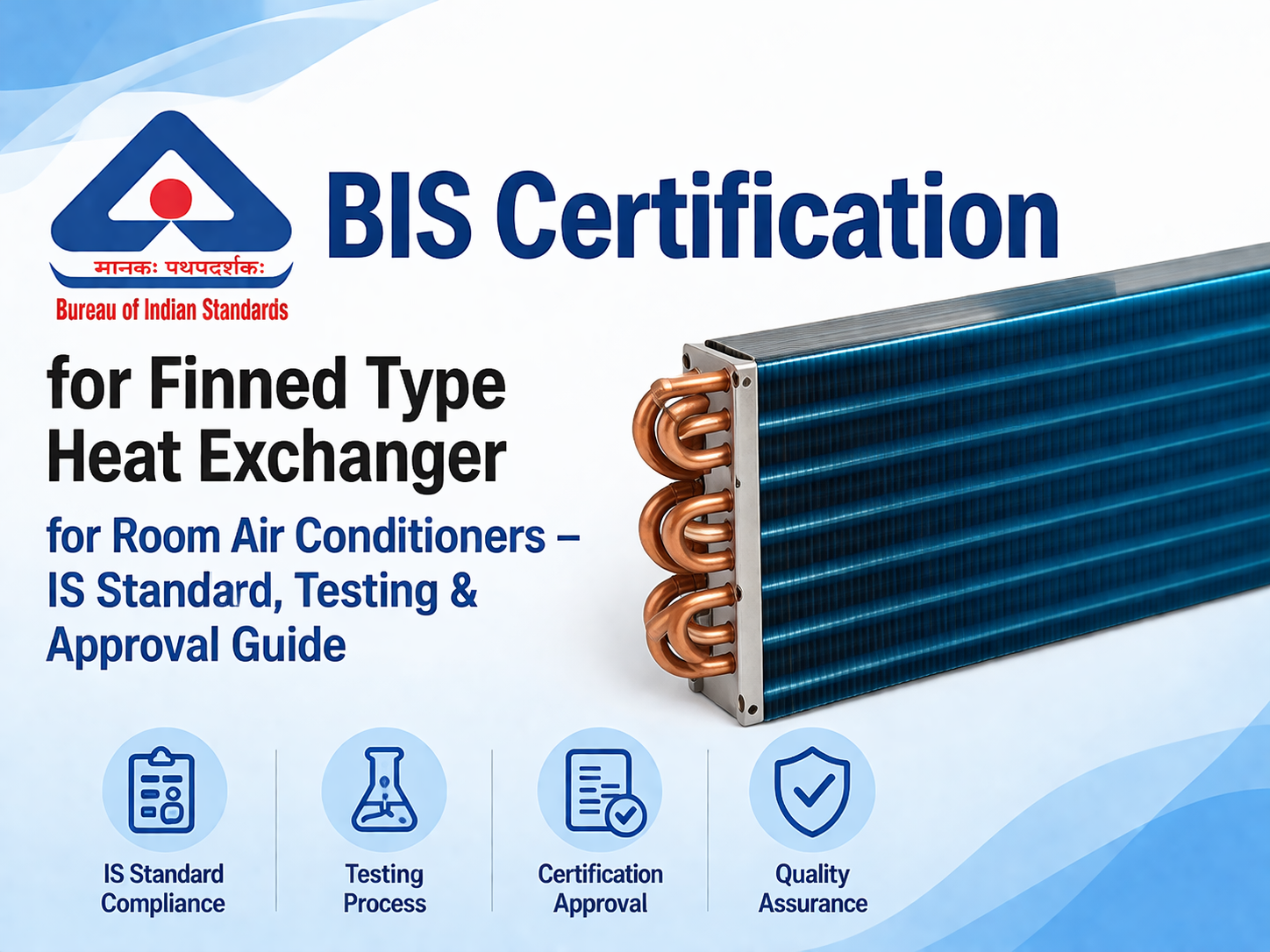
BIS Certification for Finned Type Heat Exchanger for Room Air Conditioners – IS Standard, Testing & Approval Guide
Since 2014, businesses across India and global markets have relied on expert compliance partners to simplify regulatory approvals. Among critical HVAC components, finned type heat exchangers used in room air conditioners are now under mandatory compliance, making BIS certification essential for manufacturers and importers.
This blog provides a complete guide to BIS Certification for Finned Type Heat Exchangers, covering applicable IS standards, testing requirements, and the approval process.
What is a Finned Type Heat Exchanger?
A finned type heat exchanger is a key component in room air conditioners that facilitates efficient heat transfer between refrigerant and air. The presence of fins increases the surface area, improving thermal performance and energy efficiency.
These components are widely used in:
- Split Air Conditioners
- Window AC Units
- HVAC Cooling Systems
Applicable BIS Standard – IS 11329:2018
The BIS certification for finned type heat exchangers is governed by:
👉 IS 11329:2018 – Finned Type Heat Exchangers for Room Air Conditioners
This standard defines:
- Design and construction requirements
- Material specifications (copper/aluminium tubes, aluminium fins)
- Performance and durability parameters
- Testing and inspection procedures
It ensures that the heat exchangers deliver efficient cooling, durability, and safety in air conditioning systems.
Mandatory BIS Certification Requirement
Under the Quality Control Order (QCO) for Air Conditioners & Related Parts, BIS certification is mandatory for finned type heat exchangers.
- Enforcement Date: 1 October 2023
- Certification Scheme: BIS Scheme-I (ISI Mark Certification)
- Applicable to:
- Domestic manufacturers
- Importers
- OEM suppliers
Products must bear the ISI Mark before being sold in the Indian market.
Product Classification
As per IS 11329:2018, finned heat exchangers are classified based on construction:
- Fin pack with collar & tube type
- Micro-channel tube with continuous fin type
Each category must undergo testing to ensure compliance across the entire product range.
Testing Requirements for BIS Certification
To obtain BIS certification, products must pass testing in BIS-approved laboratories. Key tests include:
1. Construction Test
Verifies design conformity and structural integrity.
2. Internal Contamination Test
Ensures cleanliness and absence of impurities.
3. Leak Test
Checks for refrigerant leakage and sealing efficiency.
4. Burst Test
Assesses pressure resistance capability.
5. Fatigue Strength Test
Evaluates durability under repeated stress.
6. Corrosion Resistance Test
Ensures long-term performance in humid conditions.
BIS Certification Process (Step-by-Step)
The BIS certification process involves the following stages:
Step 1: Application Submission
Submit application with technical details, product specifications, and test reports.
Step 2: Documentation Review
BIS examines compliance with IS 11329:2018.
Step 3: Factory Inspection
Inspection of manufacturing facility and quality control systems.
Step 4: Sample Testing
Samples are tested in BIS-recognized labs.
Step 5: Grant of License
Upon successful evaluation, BIS grants the license to use the ISI Mark.
Documents Required
Manufacturers must provide:
- Application form
- Product technical specifications
- Manufacturing process details
- Quality control plan
- Test reports
- Factory layout
- Business registration proof
- Declaration of conformity
Marking & Labelling Requirements
As per BIS norms:
- ISI Mark must be affixed on the product
- Manufacturer details must be clearly mentioned
- Product identification and batch details are mandatory
This ensures traceability and compliance verification.
Benefits of BIS Certification
Obtaining BIS certification offers multiple advantages:
- Legal compliance in India
- Improved product quality and reliability
- Enhanced market credibility
- Increased customer trust
- Competitive advantage in HVAC industry
Penalties for Non-Compliance
Non-compliance with BIS requirements can lead to:
- Product seizure
- Cancellation of license
- Financial penalties
- Imprisonment (as per BIS Act, 2016)
How SS Global Services Can Help
At SS Global Services, we simplify the entire BIS certification journey:
- End-to-end documentation support
- Coordination with BIS authorities
- Testing assistance with approved labs
- Faster approval timelines
- Compliance for domestic & foreign manufacturers
With over a decade of expertise, we ensure hassle-free certification and regulatory compliance for your products.
Conclusion
BIS Certification for Finned Type Heat Exchangers under IS 11329:2018 is now a mandatory requirement in India. From testing to factory inspection and ISI marking, the process demands technical expertise and regulatory knowledge.
Partnering with an experienced consultancy like SS Global Services helps you navigate complexities smoothly and ensures timely approvals—allowing you to focus on growing your business.