
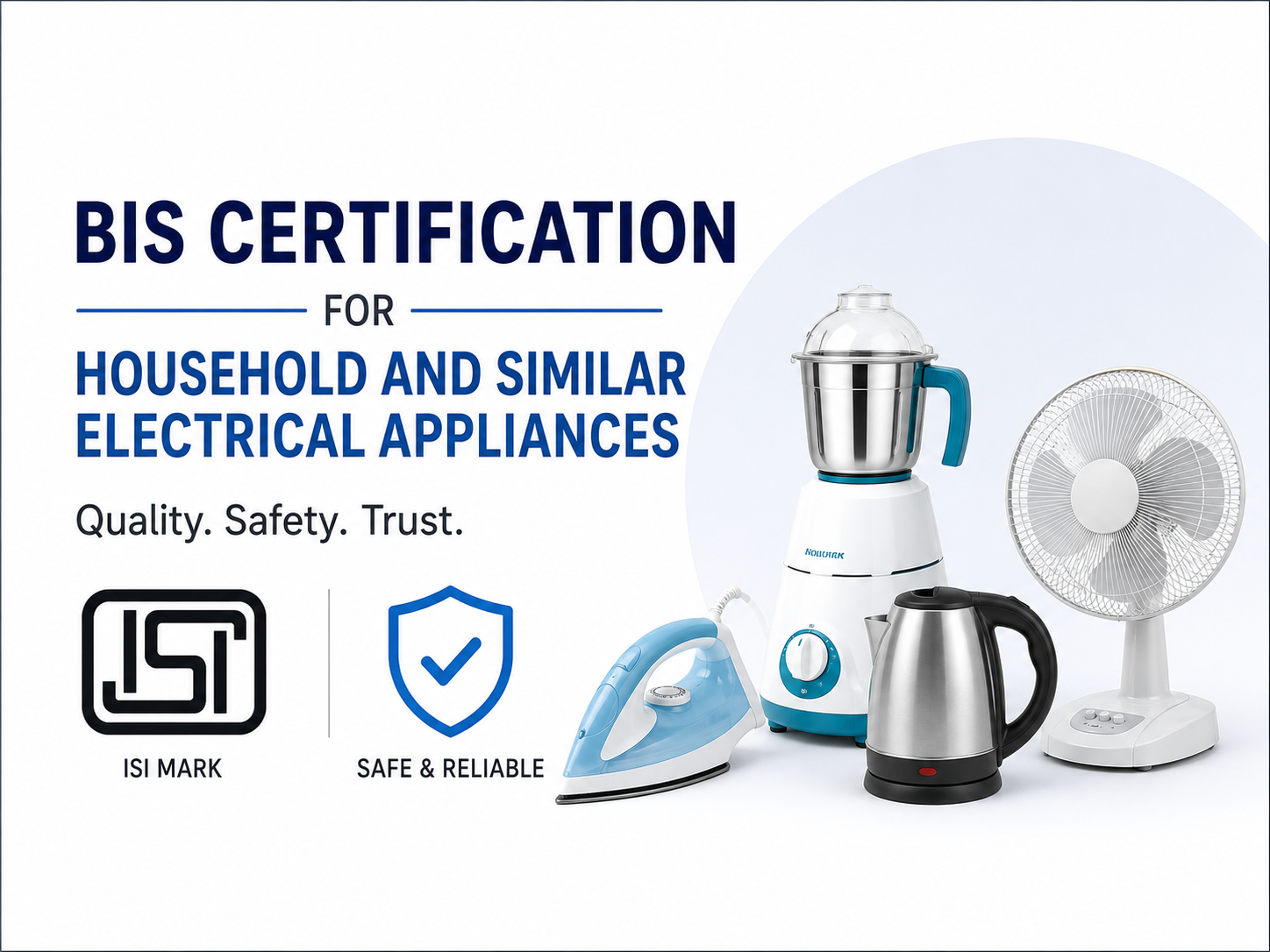
BIS Certification for Household and Similar Electrical Appliances: Complete Guide for Manufacturers
Introduction
Household and similar electrical appliances have become an essential part of modern living. Products such as electric irons, mixers, grinders, induction cooktops, electric kettles, room heaters, fans, water heaters, and other domestic appliances are used daily in homes, offices, hotels, hospitals, and commercial establishments.
Since these appliances operate on electricity, they must meet strict safety and quality requirements to protect consumers from hazards such as electric shock, fire, overheating, and mechanical failure. To ensure product safety and compliance, the Bureau of Indian Standards (BIS) has introduced certification requirements for various household electrical appliances under applicable Indian Standards and Quality Control Orders (QCOs).
Manufacturers covered under these regulations must obtain BIS Certification before manufacturing, importing, selling, or distributing their products in India.
What is BIS Certification?
The Bureau of Indian Standards (BIS) is India's National Standards Body responsible for establishing quality and safety standards for products sold in the country.
BIS Certification verifies that a product complies with the applicable Indian Standard through:
- Product testing
- Factory inspection
- Quality management verification
- Ongoing surveillance
Depending on the product category, manufacturers may obtain either:
- BIS ISI Certification (Scheme-I) for domestically manufactured products covered under mandatory certification.
- BIS CRS Registration (Compulsory Registration Scheme) for specified electronic and electrical products notified by the Government of India.
The applicable certification scheme depends on the specific appliance and its corresponding Indian Standard.
What are Household and Similar Electrical Appliances?
Household and similar electrical appliances include electrical equipment intended for domestic use or comparable applications.
Examples include:
- Electric Irons
- Mixer Grinders
- Food Processors
- Electric Kettles
- Induction Cooktops
- Rice Cookers
- Electric Pressure Cookers
- Toasters
- Sandwich Makers
- Room Heaters
- Water Heaters (Geysers)
- Electric Fans
- Vacuum Cleaners
- Washing Machines
- Dishwashers
- Air Coolers
- Hair Dryers
- Electric Shavers
- Electric Cooking Appliances
- Coffee Makers
Each product category may have its own applicable Indian Standard and certification requirements.
Why is BIS Certification Important?
Electrical appliances can pose significant risks if they are poorly designed or manufactured. Defective products may cause:
- Electric shock
- Fire hazards
- Overheating
- Electrical short circuits
- Mechanical failures
- Property damage
- Personal injuries
BIS Certification ensures that products are tested for safety, performance, and reliability before reaching consumers.
Benefits of BIS Certification
1. Legal Compliance
Manufacturers comply with mandatory BIS regulations and applicable Quality Control Orders.
2. Enhanced Consumer Safety
Certified products are tested for electrical safety and performance.
3. Improved Product Quality
Manufacturers implement standardized quality control procedures.
4. Customer Confidence
Consumers recognize BIS-certified products as reliable and trustworthy.
5. Better Market Opportunities
Many government organizations, institutional buyers, and retailers prefer certified products.
6. Competitive Advantage
Certification improves brand reputation and strengthens market credibility.
Major Testing Requirements
Depending on the applicable Indian Standard, products may undergo testing for:
- Electrical safety
- Insulation resistance
- Earth continuity
- Leakage current
- Temperature rise
- Input power verification
- Mechanical strength
- Endurance testing
- Protection against electric shock
- Moisture resistance
- Abnormal operation
- Fire resistance
- Product marking and labeling
Testing is carried out in BIS-recognized laboratories.
BIS Certification Process
The certification process generally includes the following steps:
Step 1: Product Identification
Identify the applicable Indian Standard and certification scheme for the product.
Step 2: Documentation
Prepare and submit:
- Business Registration
- Factory Licence
- Manufacturing Process
- Product Specifications
- Circuit Diagrams (where applicable)
- Quality Control Plan
- Test Equipment Details
- Factory Layout
- Authorized Signatory Documents
Step 3: Product Testing
Samples are tested in BIS-approved laboratories according to the applicable Indian Standard.
Step 4: Factory Inspection
For applicable schemes, BIS officials inspect the manufacturing facility to verify quality control and production capabilities.
Step 5: Grant of Licence or Registration
After successful evaluation, BIS grants the certification licence or registration.
Step 6: Ongoing Surveillance
Periodic inspections and testing ensure continued compliance.
Documents Required
Manufacturers generally need:
- Company Registration Certificate
- GST Registration
- Factory Licence
- Manufacturing Flow Chart
- Product Drawings
- Technical Specifications
- Test Reports
- Machinery Details
- Laboratory Equipment List
- Calibration Certificates
- Quality Manual
- Brand Authorization (if applicable)
Who Needs BIS Certification?
BIS Certification is generally applicable to:
- Electrical Appliance Manufacturers
- OEM Manufacturers
- Brand Owners
- Importers
- Foreign Manufacturers exporting products to India
- Contract Manufacturers
The applicable certification route depends on the notified product category.
Why Choose Professional BIS Consultants?
The BIS certification process involves technical documentation, product testing, regulatory compliance, and coordination with BIS authorities. Professional consultants can assist with:
- Identifying the correct Indian Standard
- Selecting the appropriate BIS certification scheme
- Preparing documentation
- Coordinating laboratory testing
- Assisting during factory inspections
- Resolving technical compliance issues
- Obtaining timely BIS approval
Professional guidance can simplify the certification process and reduce delays.
Conclusion
BIS Certification for Household and Similar Electrical Appliances plays a vital role in ensuring electrical safety, product quality, and regulatory compliance. Certified products provide consumers with confidence while helping manufacturers strengthen their brand reputation and expand market opportunities.
Manufacturers planning to introduce household electrical appliances into the Indian market should identify the applicable Indian Standard, comply with BIS requirements, and obtain the necessary certification before commercial sale.
Investing in BIS Certification is not only a legal obligation for many products but also a commitment to delivering safe, reliable, and high-quality electrical appliances.
Frequently Asked Questions (FAQs)
Is BIS Certification mandatory for all household electrical appliances?
Not all appliances fall under mandatory certification. The requirement depends on the specific product category and the applicable Quality Control Order or BIS notification. Manufacturers should verify the latest regulatory requirements for their products.
What is the difference between BIS ISI Certification and BIS CRS Registration?
BIS ISI Certification is generally applicable to products covered under Scheme-I, while BIS CRS Registration applies to specific electronic and electrical products notified under the Compulsory Registration Scheme. The applicable route depends on the product and the relevant Indian Standard.
Can foreign manufacturers obtain BIS Certification?
Yes. Foreign manufacturers exporting household electrical appliances to India can apply under the appropriate BIS certification scheme, subject to compliance with BIS requirements.
How long does the certification process take?
The timeline depends on product testing, documentation, factory inspection (where applicable), and BIS processing.
Why should manufacturers obtain BIS Certification?
BIS Certification helps ensure legal compliance, enhances product safety, builds customer trust, improves market acceptance, and supports long-term business growth.