
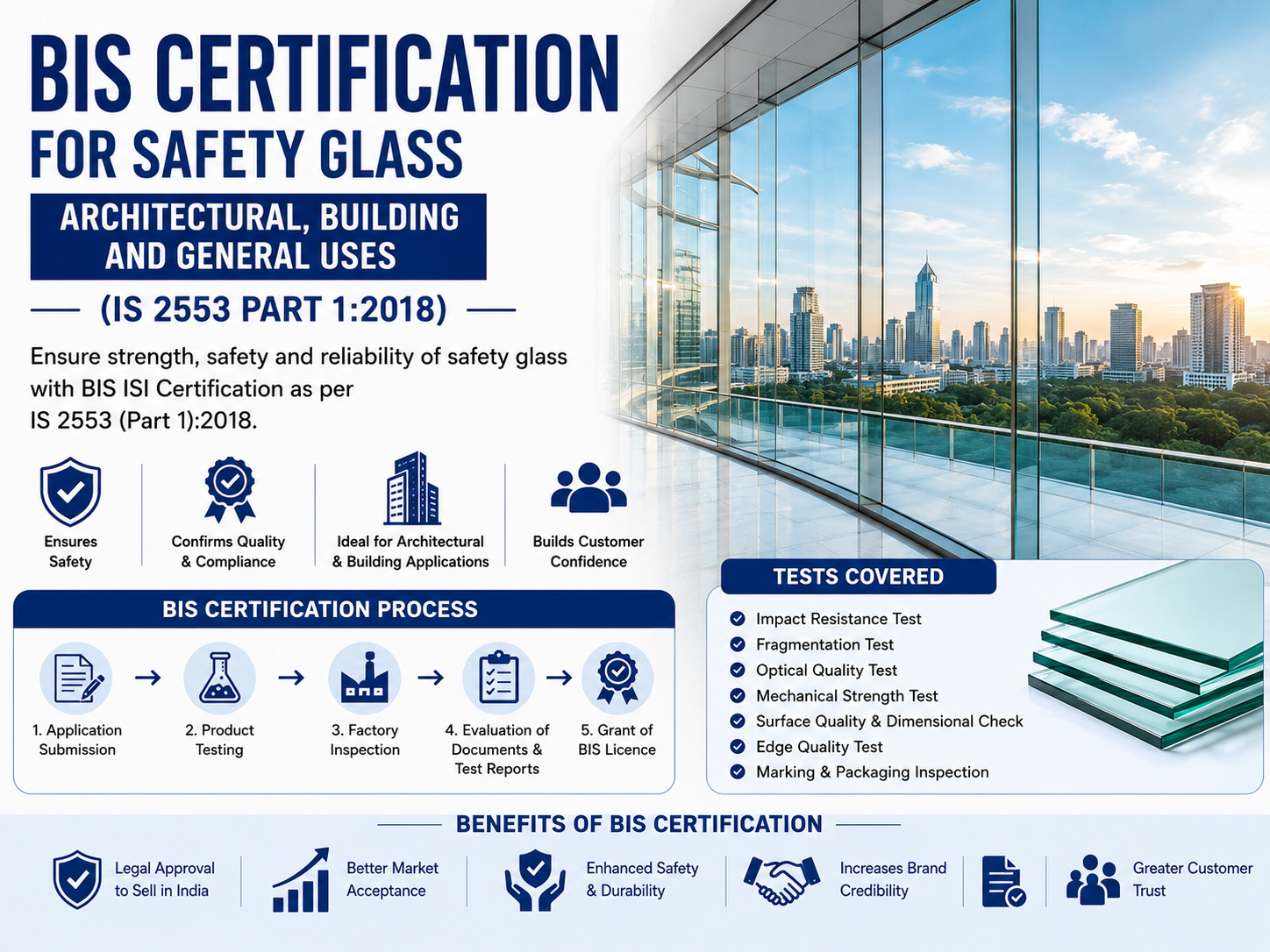
BIS Certification for Safety Glass – Architectural, Building and General Uses (IS 2553 Part 1:2018)
Safety glass is widely used in residential, commercial, institutional, and industrial buildings where enhanced strength, impact resistance, and occupant safety are essential. It is commonly installed in doors, windows, façades, partitions, skylights, railings, and other architectural applications. To ensure consistent quality and safety, manufacturers must comply with the relevant Indian standards.
The Bureau of Indian Standards (BIS) has established IS 2553 (Part 1):2018, which specifies the requirements for safety glass used in architectural, building, and general applications. Manufacturers producing applicable safety glass products are required to obtain BIS ISI Certification before marketing them in India.
At SS Global Services, we provide complete BIS certification consultancy, helping manufacturers through documentation, application filing, product testing, factory inspection, and licence approval.
What is BIS ISI Certification?
BIS ISI Certification is a product certification scheme administered by the Bureau of Indian Standards (BIS). It confirms that a product conforms to the applicable Indian Standard and meets the prescribed quality, safety, and performance requirements.
The ISI Mark serves as a symbol of quality and reliability, assuring customers, builders, architects, and regulatory authorities that the product has been manufactured under a controlled quality management system.
What is IS 2553 (Part 1):2018?
IS 2553 (Part 1):2018 specifies the requirements for safety glass used in architectural, building, and general applications. The standard lays down provisions relating to material quality, manufacturing processes, optical characteristics, mechanical strength, safety performance, testing methods, marking, and quality control.
Compliance with this standard helps ensure that safety glass offers reliable performance and minimizes the risk of injury in the event of accidental breakage.
Applications of Safety Glass
Safety glass manufactured under IS 2553 (Part 1):2018 is commonly used in:
-
Residential buildings
-
Commercial complexes
-
Office buildings
-
Shopping malls
-
Hotels and resorts
-
Hospitals
-
Educational institutions
-
Airports
-
Railway stations
-
Glass façades
-
Doors and windows
-
Partitions
-
Staircase railings
-
Skylights
-
Balconies
Its use enhances both safety and aesthetics in modern construction.
Why is BIS Certification Important?
BIS Certification helps ensure that safety glass consistently meets Indian quality and safety standards.
Key benefits include:
-
Compliance with Indian regulations
-
Improved occupant safety
-
Consistent product quality
-
Enhanced impact resistance
-
Increased customer confidence
-
Better market acceptance
-
Stronger brand credibility
-
Eligibility for government and institutional projects
Certification demonstrates a manufacturer's commitment to quality and regulatory compliance.
Quality Requirements Under IS 2553 (Part 1):2018
The standard specifies requirements relating to:
-
Glass quality
-
Optical clarity
-
Flatness
-
Surface finish
-
Mechanical strength
-
Impact resistance
-
Fragmentation characteristics
-
Dimensional accuracy
-
Edge quality
-
Product marking
-
Packaging requirements
-
Quality control procedures
Manufacturers must maintain effective production and quality assurance systems to ensure consistent compliance.
Testing Requirements for Safety Glass
Before obtaining BIS ISI Certification, safety glass undergoes comprehensive laboratory testing.
1. Impact Resistance Test
Evaluates the glass's ability to withstand impact without causing dangerous breakage.
2. Fragmentation Test
Assesses the breakage pattern to ensure fragments comply with safety requirements.
3. Optical Quality Test
Verifies transparency, visual clarity, and the absence of unacceptable optical defects.
4. Dimensional Verification
Checks glass thickness, dimensions, and manufacturing tolerances.
5. Surface Quality Inspection
Examines the glass for scratches, bubbles, inclusions, distortions, and other surface defects.
6. Mechanical Strength Test
Measures the structural performance of the glass under specified loading conditions.
7. Marking and Packaging Verification
Ensures compliance with BIS marking, identification, and packaging requirements.
These tests help ensure that the glass is safe, durable, and suitable for architectural applications.
Documents Required for BIS Certification
Manufacturers generally need to submit:
-
Company registration documents
-
Factory licence
-
Manufacturing process flow chart
-
Product specifications
-
Quality Control Plan
-
Manufacturing machinery details
-
Laboratory testing equipment list
-
Calibration certificates
-
Raw material specifications
-
Technical drawings
-
Quality management records
-
Authorized signatory documents
-
Previous test reports, where applicable
Proper documentation facilitates smooth processing of the certification application.
BIS Certification Process
The certification process generally includes the following steps:
Step 1: Product Assessment
Confirm that the product falls within the scope of IS 2553 (Part 1):2018.
Step 2: Documentation Preparation
Prepare all technical documents, manufacturing details, and quality records required by BIS.
Step 3: Application Submission
Submit the BIS application along with supporting documents.
Step 4: Product Testing
Product samples are tested in a BIS-recognized laboratory to verify compliance with the applicable standard.
Step 5: Factory Inspection
BIS officials inspect the manufacturing facility, production process, laboratory, testing infrastructure, and quality management system.
Step 6: Grant of BIS Licence
After successful evaluation of documentation, product testing, and factory inspection, BIS grants the licence authorizing the use of the ISI Mark.
Common Challenges During Certification
Manufacturers often face challenges such as:
-
Incomplete documentation
-
Product testing delays
-
Calibration deficiencies
-
Quality management gaps
-
Factory inspection observations
-
Incorrect application details
-
Non-compliance with standard requirements
Professional consultancy helps minimize these challenges and speeds up the certification process.
Why Choose SS Global Services?
SS Global Services provides complete BIS certification consultancy for manufacturers across India.
Our services include:
-
Product applicability assessment
-
BIS documentation preparation
-
Application filing and coordination
-
Quality Control Plan preparation
-
Scheme of Inspection and Testing (SIT)
-
Technical documentation support
-
Laboratory testing coordination
-
Factory inspection preparation
-
Compliance consulting
-
End-to-end BIS certification support
Our experienced consultants ensure that your certification process is completed efficiently while maintaining full compliance with BIS requirements.
Benefits of BIS ISI Certification
Obtaining BIS Certification provides several business advantages:
-
Legal authorization to market products in India
-
Improved product quality
-
Enhanced customer confidence
-
Stronger brand reputation
-
Better market competitiveness
-
Compliance with Indian regulations
-
Increased business opportunities
-
Greater acceptance in construction and infrastructure projects
Who Should Apply?
BIS Certification under IS 2553 (Part 1):2018 is applicable to:
-
Safety glass manufacturers
-
Architectural glass manufacturers
-
Building glass manufacturers
-
Processed glass manufacturers
-
Glass fabrication companies
-
OEM manufacturers
-
Importers of applicable safety glass products
Conclusion
BIS ISI Certification under IS 2553 (Part 1):2018 is an essential quality certification for manufacturers of safety glass used in architectural, building, and general applications. Compliance with this standard ensures that products meet stringent safety, quality, and performance requirements while satisfying applicable regulatory obligations.
Obtaining BIS certification enhances customer confidence, strengthens market credibility, and enables manufacturers to supply safe, reliable, and high-quality safety glass for modern construction projects.
SS Global Services offers complete end-to-end consultancy for BIS Certification, including documentation preparation, application filing, laboratory testing coordination, factory inspection support, and post-certification guidance. Our expert team is committed to helping manufacturers achieve certification efficiently while maintaining full compliance with BIS standards.