
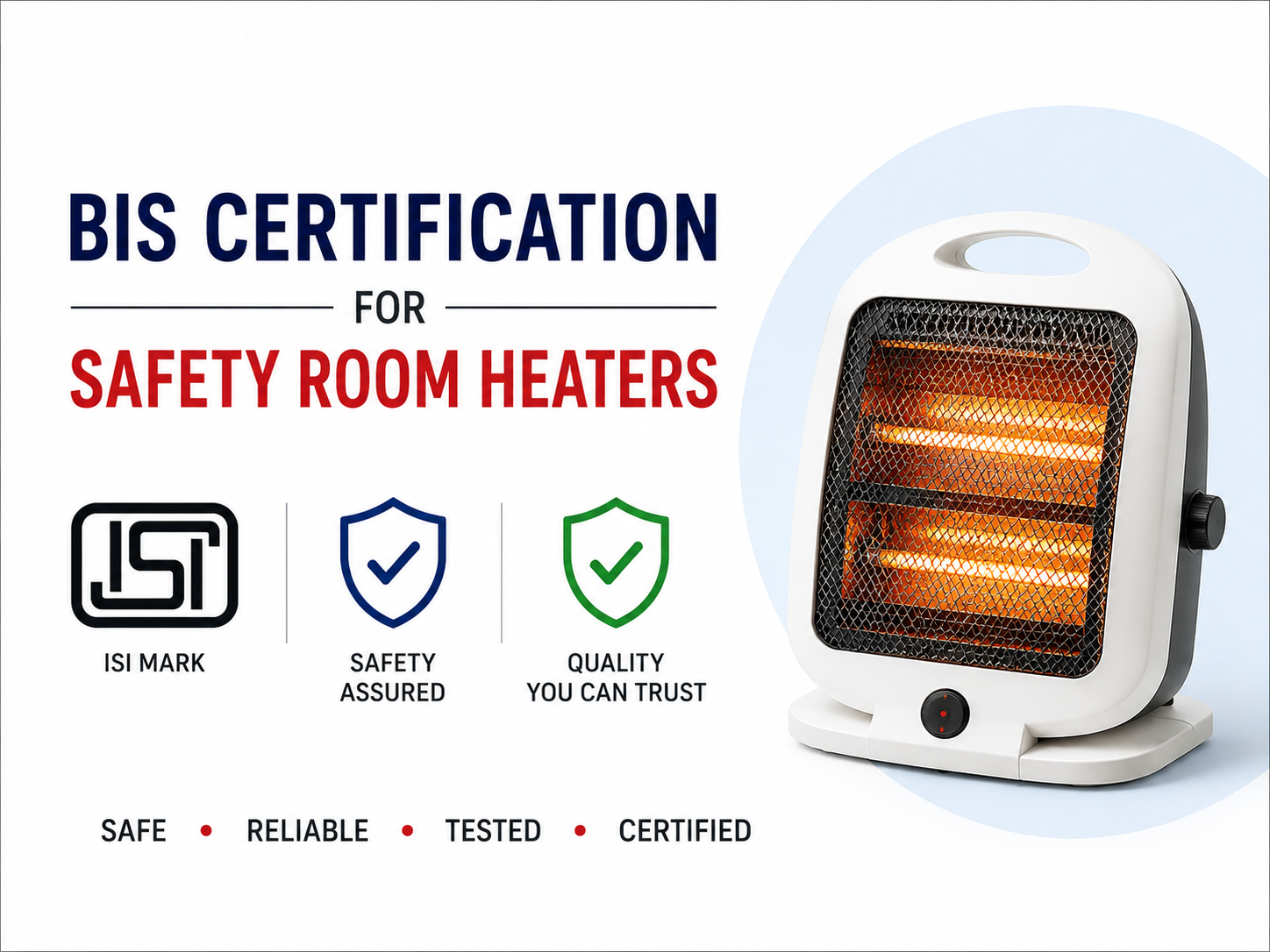
BIS Certification for Safety Room Heaters: Complete Guide for Manufacturers in India
Introduction
Safety room heaters are among the most widely used electrical appliances during winter, providing efficient heating for homes, offices, hotels, hospitals, educational institutions, and commercial spaces. Since these appliances operate using electricity and generate high temperatures, they must comply with stringent safety and quality standards to protect users from electrical hazards, fire risks, overheating, and mechanical failures.
To ensure consumer safety and product reliability, the Bureau of Indian Standards (BIS) has established certification requirements for safety room heaters under the applicable Indian Standards. Manufacturers covered under the relevant Quality Control Orders (QCOs) must obtain BIS Certification before manufacturing, importing, selling, or distributing safety room heaters in India.
BIS-certified products demonstrate compliance with Indian safety requirements and enhance customer confidence in the quality and reliability of the appliance.
What is BIS Certification?
The Bureau of Indian Standards (BIS) is India's National Standards Body responsible for developing product standards and administering certification schemes.
Depending on the applicable product category, safety room heaters may require certification under:
-
BIS ISI Certification (Scheme-I), or
-
BIS Compulsory Registration Scheme (CRS) (where applicable).
Manufacturers must identify the correct certification route based on the applicable Indian Standard and current BIS notifications.
BIS Certification confirms that the product has been evaluated for safety, quality, and performance through testing and compliance assessment.
What are Safety Room Heaters?
Safety room heaters are electrical heating appliances designed to provide controlled heating for indoor environments.
Common types include:
-
Fan Room Heaters
-
Radiant Room Heaters
-
Quartz Heaters
-
Halogen Heaters
-
Oil-Filled Radiator Heaters
-
Convector Heaters
-
Ceramic Room Heaters
-
PTC Heaters
These appliances are used in:
-
Residential homes
-
Offices
-
Hotels
-
Hospitals
-
Schools
-
Retail establishments
-
Government buildings
Why is BIS Certification Important?
Electrical heating appliances operate at high temperatures and can pose serious safety risks if not properly designed or manufactured.
Potential hazards include:
-
Electric shock
-
Fire accidents
-
Overheating
-
Short circuits
-
Component failure
-
Burns
-
Property damage
BIS Certification ensures that safety room heaters comply with prescribed electrical and mechanical safety requirements before reaching consumers.
Benefits of BIS Certification
1. Regulatory Compliance
Ensures compliance with applicable BIS regulations and government notifications.
2. Enhanced Product Safety
Products are tested to minimize electrical and thermal hazards.
3. Improved Product Quality
Manufacturers follow standardized production and quality control procedures.
4. Increased Consumer Confidence
Customers prefer products that comply with recognized Indian safety standards.
5. Competitive Advantage
Certified products are preferred by retailers, institutional buyers, and government organizations.
6. Strong Brand Reputation
BIS Certification demonstrates a commitment to quality and consumer safety.
Major Testing Requirements
Depending on the applicable Indian Standard, safety room heaters may undergo testing for:
-
Protection against electric shock
-
Insulation resistance
-
Earth continuity
-
Leakage current
-
Input power verification
-
Temperature rise
-
Heating performance
-
Mechanical strength
-
Abnormal operation
-
Moisture resistance
-
Stability
-
Fire resistance
-
Endurance
-
Product marking and labeling
Testing is conducted in BIS-recognized laboratories.
BIS Certification Process
The certification process generally includes the following steps:
Step 1: Product Classification
Identify the applicable Indian Standard and certification scheme.
Step 2: Documentation
Manufacturers prepare:
-
Business Registration
-
Factory Licence
-
GST Registration
-
Product Specifications
-
Circuit Diagrams (where applicable)
-
Manufacturing Process
-
Quality Control Plan
-
Factory Layout
-
Machinery Details
-
Laboratory Equipment List
Step 3: Product Testing
Samples are tested in BIS-approved laboratories for compliance with the relevant Indian Standard.
Step 4: Factory Inspection
For applicable schemes, BIS officials inspect the manufacturing facility to verify production capability and quality control systems.
Step 5: Grant of Certification
Upon successful evaluation, BIS grants the certification licence or registration.
Step 6: Ongoing Surveillance
Periodic inspections and testing ensure continued compliance with BIS requirements.
Documents Required
Manufacturers generally need:
-
Company Registration Certificate
-
Factory Licence
-
GST Registration
-
Product Drawings
-
Technical Specifications
-
Manufacturing Flow Chart
-
Machinery Details
-
Laboratory Equipment List
-
Calibration Certificates
-
Quality Manual
-
Test Reports (if available)
Who Needs BIS Certification?
BIS Certification may apply to:
-
Room Heater Manufacturers
-
Electrical Appliance Manufacturers
-
OEM Manufacturers
-
Contract Manufacturers
-
Brand Owners
-
Importers
-
Foreign Manufacturers exporting products to India
Manufacturers should verify whether their specific product category falls under mandatory BIS certification requirements.
Why Choose Professional BIS Consultants?
Obtaining BIS Certification requires technical documentation, laboratory testing, regulatory compliance, and coordination with BIS authorities.
Professional consultants can assist with:
-
Identifying the applicable Indian Standard
-
Preparing technical documentation
-
Filing BIS applications
-
Coordinating product testing
-
Factory inspection support
-
Regulatory compliance
-
Faster certification approval
Expert guidance helps manufacturers avoid delays and ensures a smoother certification process.
Conclusion
BIS Certification for Safety Room Heaters is essential for ensuring electrical safety, product quality, and compliance with Indian regulations. Certified products provide greater confidence to consumers while helping manufacturers strengthen their market presence and brand reputation.
Manufacturers planning to sell safety room heaters in India should identify the applicable BIS certification scheme, comply with the relevant Indian Standard, and obtain certification before introducing their products into the market.
Obtaining BIS Certification is not only a regulatory requirement for many products but also a valuable investment in product safety, customer trust, and long-term business success.
Frequently Asked Questions (FAQs)
Is BIS Certification mandatory for Safety Room Heaters?
The requirement depends on the applicable Indian Standard and any notified Quality Control Order (QCO). Manufacturers should verify the latest BIS notification for their specific product category.
What is the difference between BIS ISI Certification and BIS CRS?
BIS ISI Certification generally applies to products certified under Scheme-I, while BIS CRS applies to specified electronic and electrical products notified under the Compulsory Registration Scheme. The applicable route depends on the product.
Can foreign manufacturers obtain BIS Certification?
Yes. Foreign manufacturers exporting safety room heaters to India can apply under the applicable BIS certification scheme, subject to compliance with BIS requirements.
How long does BIS Certification take?
The timeline depends on documentation, product testing, factory inspection (where applicable), and BIS processing.
What are the advantages of BIS Certification?
BIS Certification improves product quality, ensures regulatory compliance, enhances customer confidence, strengthens brand reputation, and supports business growth.
SEO Keywords
-
BIS Certification for Safety Room Heaters
-
BIS Certification for Room Heaters
-
BIS ISI Certification
-
BIS CRS Registration
-
Room Heater BIS Certification India
-
Electrical Appliance BIS Certification
-
ISI Mark for Room Heaters
-
Bureau of Indian Standards
-
BIS Consultant for Electrical Appliances
-
BIS Certification India