
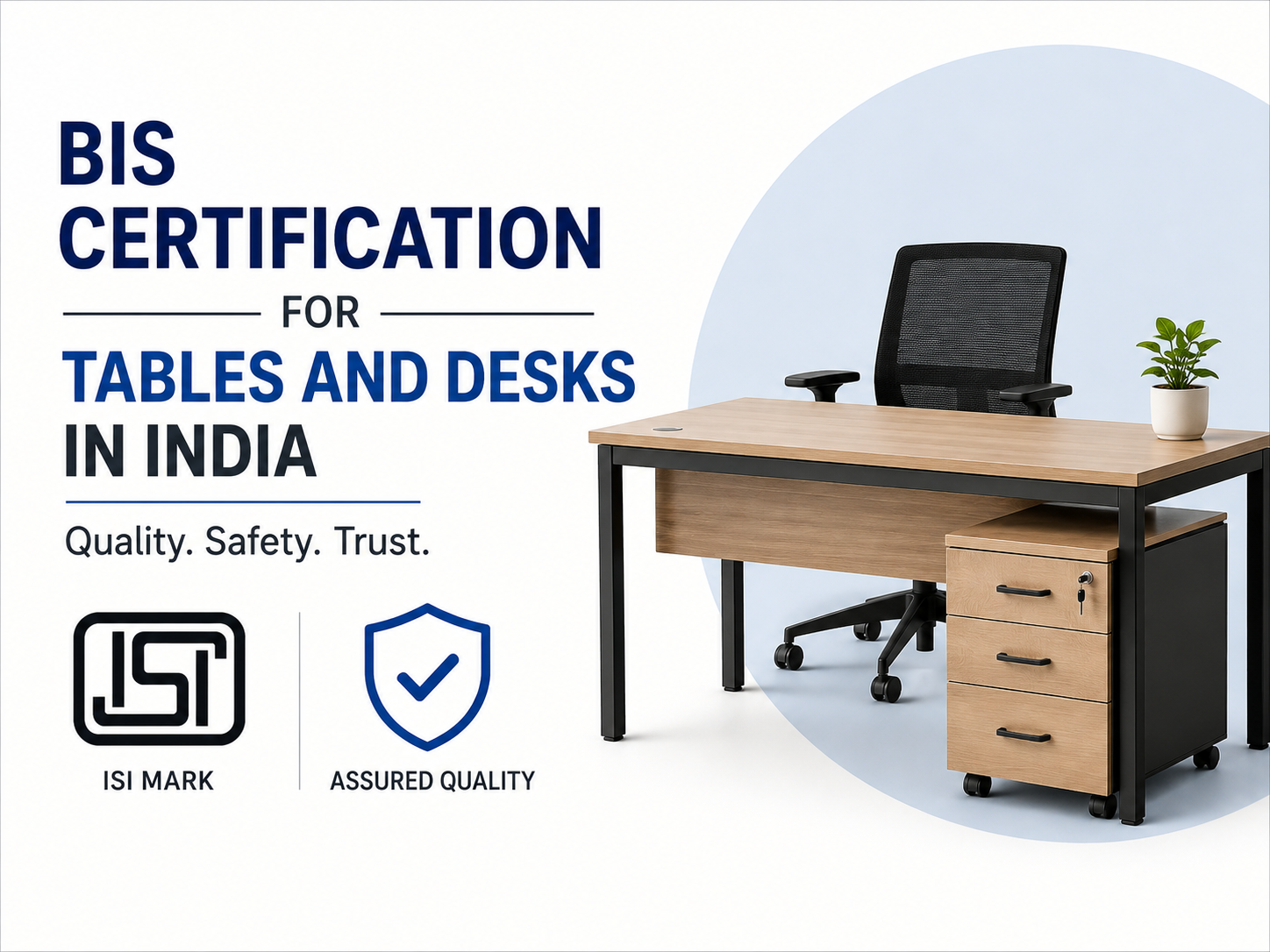
BIS Certification for Tables and Desks in India: Complete Guide for Manufacturers
Introduction
Tables and desks are essential furniture products used in homes, offices, educational institutions, hospitals, hotels, commercial establishments, and industrial workplaces. Whether used as office workstations, study desks, conference tables, dining tables, or utility tables, these products must offer durability, stability, safety, and long-term performance.
To maintain consistent product quality and consumer safety, the Bureau of Indian Standards (BIS) has established quality standards for furniture products, including various types of tables and desks. Where notified under applicable Quality Control Orders (QCOs), manufacturers must obtain BIS Certification before manufacturing, importing, selling, or distributing such products in India.
BIS Certification assures buyers that the product complies with the applicable Indian Standard and has undergone quality assessment through testing and inspection.
What is BIS Certification?
The Bureau of Indian Standards (BIS) is the National Standards Body of India responsible for developing quality standards and administering product certification.
Under the ISI Certification Scheme, BIS authorizes manufacturers to use the ISI Mark after confirming that their products comply with the relevant Indian Standard through:
- Product testing
- Factory inspection
- Quality management verification
- Periodic surveillance
The ISI Mark represents:
- Product quality
- Consumer safety
- Manufacturing consistency
- Regulatory compliance
- Reliable performance
What are Tables and Desks?
Tables and desks are furniture products designed for writing, working, dining, studying, meetings, storage, or utility purposes.
Common categories include:
- Office Tables
- Office Desks
- Computer Tables
- Study Tables
- Executive Desks
- Conference Tables
- Dining Tables
- Laboratory Tables
- Industrial Work Tables
- Training Tables
- School Desks
- Folding Tables
- Utility Tables
These products are manufactured using materials such as steel, wood, engineered wood, plastic, aluminum, and composite materials.
Why is BIS Certification Important?
Furniture products are subjected to continuous mechanical loads throughout their service life. Poor-quality tables and desks may lead to instability, structural failure, safety hazards, and reduced product lifespan.
BIS Certification helps ensure that products:
- Meet prescribed quality standards
- Provide structural strength
- Offer long-term durability
- Maintain dimensional accuracy
- Ensure user safety
- Comply with Indian regulations
Benefits of BIS Certification
1. Regulatory Compliance
Manufacturers comply with applicable BIS regulations and Quality Control Orders.
2. Improved Product Quality
Standardized manufacturing practices improve consistency and reduce defects.
3. Enhanced Customer Confidence
Consumers trust products carrying the BIS certification mark.
4. Competitive Advantage
Certified products are preferred by institutional buyers, corporate organizations, and government departments.
5. Business Expansion
Certification supports participation in government tenders and large procurement projects.
6. Strong Brand Reputation
BIS Certification demonstrates a commitment to quality and customer satisfaction.
Major Quality Requirements
Depending on the applicable Indian Standard, tables and desks are evaluated for:
- Material quality
- Structural strength
- Stability
- Workmanship
- Surface finish
- Dimensional accuracy
- Load-bearing capacity
- Durability
- Safety
- Product marking
Testing is carried out in BIS-recognized laboratories according to the applicable Indian Standard.
BIS Certification Process
The certification process generally includes the following steps:
Step 1: Application Submission
Submit the BIS application with manufacturing and product details.
Step 2: Documentation
Manufacturers provide:
- Factory Registration
- GST Registration
- Manufacturing Process
- Product Specifications
- Quality Control Plan
- Machinery Details
- Laboratory Equipment List
- Product Drawings
- Authorized Signatory Documents
Step 3: Factory Inspection
BIS officials inspect the manufacturing facility to verify production capability and quality control systems.
Step 4: Product Testing
Samples are tested in BIS-recognized laboratories for compliance with the relevant Indian Standard.
Step 5: Grant of Licence
Upon successful evaluation, BIS grants the certification licence.
Step 6: Surveillance
Periodic inspections and product testing ensure continued compliance.
Documents Required
Manufacturers generally need:
- Company Registration Certificate
- Factory Licence
- GST Registration
- Manufacturing Flow Chart
- Plant Layout
- Machinery Details
- Product Drawings
- Laboratory Equipment List
- Calibration Certificates
- Quality Manual
- Raw Material Details
- Test Reports (if available)
Who Needs BIS Certification?
BIS Certification may be applicable to:
- Furniture Manufacturers
- Office Furniture Manufacturers
- OEM Manufacturers
- Contract Manufacturers
- Brand Owners
- Importers (where applicable)
- Foreign Manufacturers supplying products to India
Manufacturers should verify whether their product category is covered under a mandatory BIS notification or Quality Control Order.
Why Choose Professional BIS Consultants?
The BIS certification process involves technical documentation, testing coordination, factory inspections, and regulatory compliance. Professional consultants can assist with:
- Identifying the applicable Indian Standard
- Preparing technical documentation
- Filing BIS applications
- Coordinating laboratory testing
- Inspection preparation
- Regulatory compliance support
- Faster licence approval
Professional assistance helps simplify the certification process and minimizes delays.
Conclusion
BIS Certification for Tables and Desks helps ensure that furniture products meet recognized standards of quality, safety, durability, and performance. Certified products provide confidence to consumers, institutional buyers, government organizations, and commercial establishments.
Manufacturers planning to market tables and desks in India should identify the applicable Indian Standard, comply with BIS requirements, and obtain the necessary certification before introducing their products into the market.
Obtaining BIS Certification is not only a step toward regulatory compliance but also an investment in product quality, customer trust, and sustainable business growth.
Frequently Asked Questions (FAQs)
Is BIS Certification mandatory for Tables and Desks?
The requirement depends on whether the product is covered under an applicable Quality Control Order (QCO) or mandatory BIS notification. Manufacturers should verify the latest regulatory requirements for their product category.
What is the ISI Mark?
The ISI Mark is the certification mark issued by the Bureau of Indian Standards, indicating that a product conforms to the relevant Indian Standard.
Can foreign manufacturers obtain BIS Certification?
Yes. Foreign manufacturers exporting tables and desks to India can obtain BIS certification under the applicable BIS certification scheme, subject to compliance with regulatory requirements.
How long does BIS Certification take?
The certification timeline depends on documentation, product testing, factory inspection (where applicable), and BIS processing.
What are the benefits of BIS Certification?
BIS Certification helps manufacturers comply with regulations, improve product quality, enhance customer confidence, strengthen brand reputation, and increase opportunities in government and institutional procurement.