
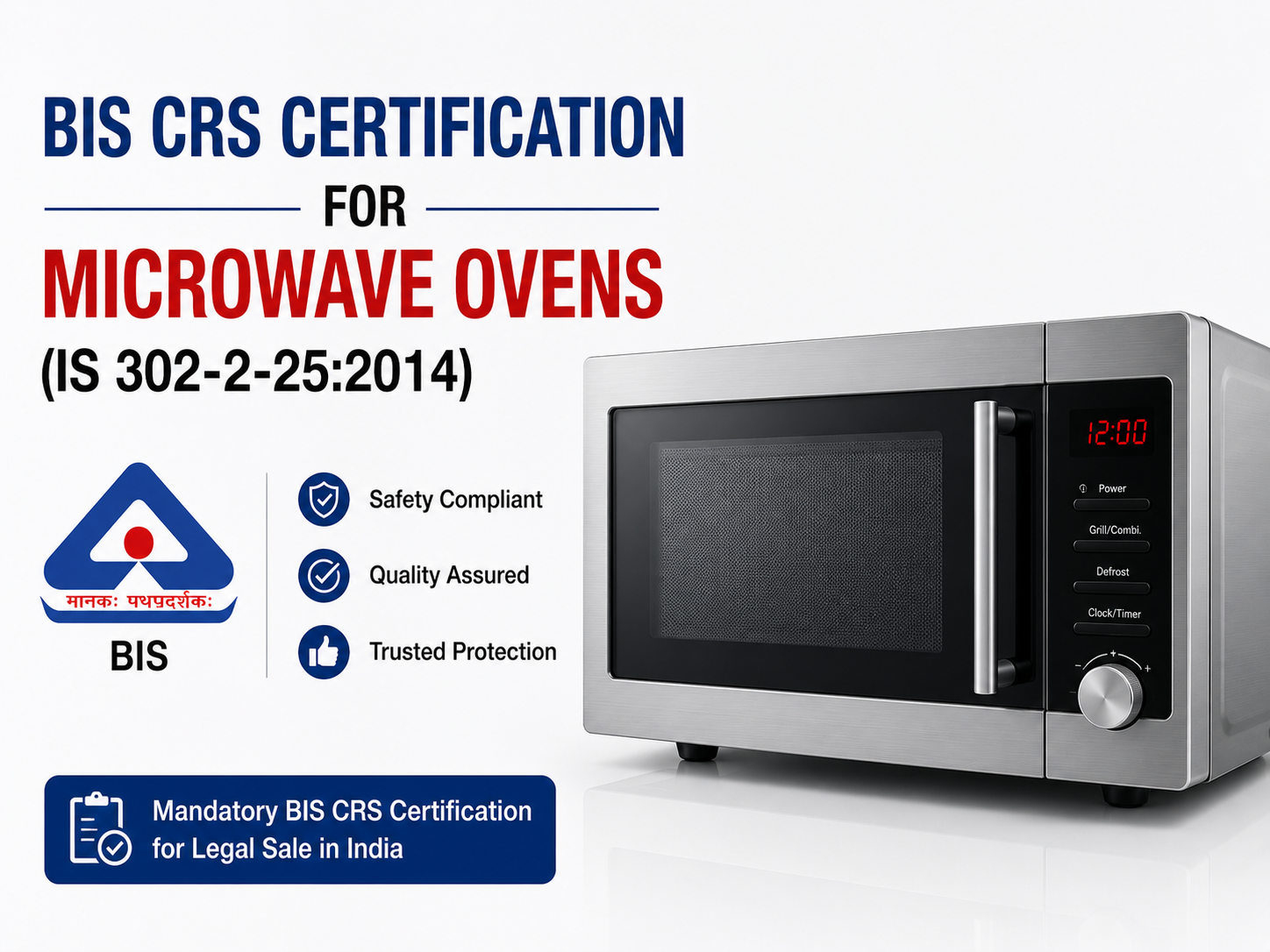
BIS CRS Certification for Microwave Ovens (IS 302-2-25:2014)
Complete Guide to BIS CRS Certification for Microwave Oven Manufacturers and Importers in India
Microwave ovens have become an essential kitchen appliance in homes, restaurants, hotels, offices, and commercial establishments. They provide quick cooking, reheating, grilling, and defrosting functions, making food preparation more convenient. Since microwave ovens are electrical appliances that operate at high voltage and generate electromagnetic energy, ensuring their safety is critical.
To protect consumers and maintain product quality, the Bureau of Indian Standards (BIS) has included microwave ovens under the Compulsory Registration Scheme (CRS). Manufacturers and importers intending to sell microwave ovens in India must obtain BIS CRS Certification and comply with IS 302 (Part 2/Sec 25):2014, which specifies the safety requirements for microwave ovens, including combination microwave ovens.
What is BIS CRS Certification?
The BIS Compulsory Registration Scheme (CRS) is a mandatory product registration program administered by the Bureau of Indian Standards (BIS) under the Electronics and Information Technology Goods (Requirement for Compulsory Registration) Order.
Under this scheme, manufacturers must have their products tested in a BIS-recognized laboratory and obtain BIS registration before manufacturing, importing, distributing, or selling covered products in India. Once registered, the product can bear the Standard Mark along with the applicable BIS Registration Number.
About IS 302 (Part 2/Sec 25):2014
IS 302 (Part 2/Sec 25):2014 specifies the safety requirements for microwave ovens intended for household and similar use, including combination microwave ovens.
The standard addresses various safety aspects, including:
-
Electrical safety
-
Protection against electric shock
-
Microwave radiation leakage
-
Temperature limits
-
Mechanical safety
-
Fire hazards
-
Construction requirements
-
Performance under normal and abnormal operating conditions
-
Marking and user instructions
Compliance with this standard helps ensure safe operation throughout the product's service life.
Products Covered
The standard generally applies to:
-
Domestic microwave ovens
-
Countertop microwave ovens
-
Grill microwave ovens
-
Convection microwave ovens
-
Combination microwave ovens
-
Built-in microwave ovens
-
Commercial microwave ovens covered under the applicable scope
Manufacturers should verify the applicability of their products before applying for BIS CRS registration.
Benefits of BIS CRS Certification
Obtaining BIS CRS Certification provides several important advantages:
-
Mandatory compliance with Indian regulations
-
Legal authorization to sell products in India
-
Increased consumer confidence
-
Enhanced product credibility
-
Improved product safety
-
Better acceptance by retailers and e-commerce platforms
-
Competitive advantage in the marketplace
-
Reduced risk of regulatory action
-
Stronger brand reputation
BIS CRS Certification Process
The registration process generally consists of the following stages:
1. Preparation of Documentation
Manufacturers prepare technical documents, product specifications, and quality-related records.
2. Product Testing
Representative product samples are tested at a BIS-recognized laboratory according to IS 302 (Part 2/Sec 25):2014.
3. Online Application Submission
The manufacturer submits the application along with laboratory test reports and supporting documents through the BIS portal.
4. Document Verification
BIS verifies the submitted documents, test reports, product details, and manufacturer information.
5. Grant of BIS CRS Registration
Upon successful verification, BIS grants the registration certificate, allowing the manufacturer to use the Standard Mark and Registration Number on compliant products.
Documents Required
The following documents are generally required:
-
Manufacturer's business registration certificate
-
Factory license
-
Manufacturing address proof
-
Product specifications
-
Circuit diagram
-
PCB layout (where applicable)
-
User manual
-
Product photographs
-
Trademark authorization (if applicable)
-
Authorized signatory details
-
BIS-recognized laboratory test report
-
ISO 9001 certificate (where applicable)
-
Authorization letter for the Indian Authorized Representative (for foreign manufacturers)
Testing Requirements
Microwave ovens are tested for compliance with IS 302 (Part 2/Sec 25):2014. Depending on the product design and scope, testing may include:
-
Protection against electric shock
-
Input power and current measurement
-
Heating performance
-
Microwave leakage test
-
Temperature rise test
-
Insulation resistance
-
Dielectric strength
-
Earth continuity
-
Mechanical strength
-
Stability testing
-
Abnormal operation test
-
Fire resistance evaluation
-
Marking and labeling verification
These tests ensure that the product operates safely under normal and foreseeable conditions.
Who Should Apply?
BIS CRS Certification is applicable to:
-
Indian manufacturers of microwave ovens
-
Foreign manufacturers exporting microwave ovens to India
-
Brand owners marketing microwave ovens under their own brand, subject to BIS registration requirements
-
Importers dealing in registered microwave oven models
Why Choose Professional BIS CRS Consultancy?
The BIS CRS registration process involves technical documentation, laboratory testing, regulatory compliance, and application management. Professional consultants help manufacturers by:
-
Preparing complete documentation
-
Identifying applicable standards
-
Coordinating product testing
-
Filing BIS applications accurately
-
Responding to BIS observations
-
Assisting with grant of registration
-
Supporting renewals and model additions
Professional guidance helps reduce approval timelines and minimizes compliance-related delays.
Conclusion
BIS CRS Certification for Microwave Ovens under IS 302 (Part 2/Sec 25):2014 is mandatory for manufacturers and importers supplying these appliances in the Indian market. Compliance with the applicable Indian Standard demonstrates a commitment to electrical safety, product quality, and regulatory requirements. By obtaining BIS CRS Registration, businesses can legally market their products, strengthen customer confidence, and enhance their competitiveness in India's growing home appliance sector.