
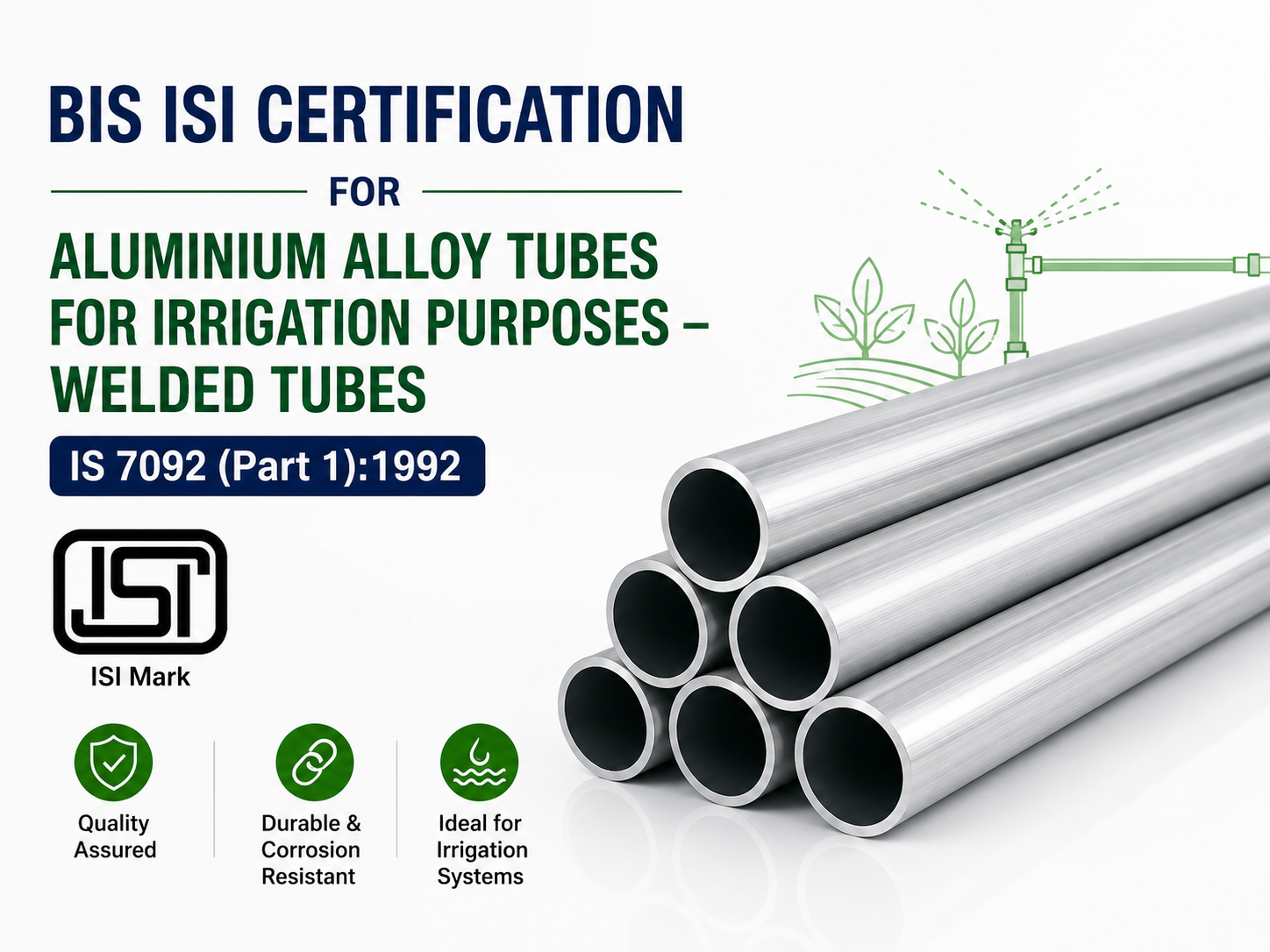
BIS ISI Certification for Aluminium Alloy Tubes for Irrigation Purposes – Welded Tubes (IS 7092 Part 1:1992)
Complete Guide to BIS ISI Certification for Aluminium Alloy Welded Irrigation Tube Manufacturers in India
Aluminium alloy welded tubes are extensively used in agricultural irrigation systems because of their lightweight construction, corrosion resistance, durability, and ease of installation. These tubes play a crucial role in portable irrigation networks, sprinkler systems, and water distribution pipelines, helping farmers improve irrigation efficiency while reducing maintenance costs.
To ensure the quality and reliability of these products, the Bureau of Indian Standards (BIS) has established IS 7092 (Part 1):1992, which specifies the requirements for Aluminium Alloy Tubes for Irrigation Purposes – Welded Tubes. Manufacturers intending to sell these products in India with the ISI Mark must obtain a BIS ISI Certification and comply with the applicable Indian Standard.
What is BIS ISI Certification?
BIS ISI Certification is a product certification scheme administered by the Bureau of Indian Standards (BIS). It verifies that a product conforms to the applicable Indian Standard through product testing, factory inspection, and quality management assessment.
After successful certification, manufacturers receive a BIS license authorizing them to use the ISI Mark, indicating that their products meet the required quality, safety, and performance standards.
About IS 7092 (Part 1):1992
IS 7092 (Part 1):1992 specifies the requirements for welded aluminium alloy tubes intended for irrigation purposes. The standard covers:
-
Material composition
-
Manufacturing process
-
Dimensions and tolerances
-
Mechanical properties
-
Workmanship and finish
-
Testing procedures
-
Sampling methods
-
Inspection requirements
-
Product marking
Compliance with this standard ensures that irrigation tubes deliver reliable performance under field conditions.
Applications of Aluminium Alloy Welded Irrigation Tubes
These tubes are widely used in:
-
Agricultural irrigation systems
-
Portable irrigation pipelines
-
Sprinkler irrigation systems
-
Farm water distribution networks
-
Horticulture projects
-
Plantation irrigation
-
Government irrigation schemes
-
Water conveyance systems
-
Rural irrigation infrastructure
Benefits of BIS ISI Certification
Obtaining BIS Certification offers several important advantages:
-
Compliance with Indian quality regulations
-
Authorization to use the ISI Mark
-
Improved product quality and consistency
-
Increased customer confidence
-
Enhanced brand reputation
-
Better acceptance in government procurement
-
Competitive advantage in the irrigation equipment market
-
Reduced product failures and customer complaints
-
Easier market access across India
Key Requirements under IS 7092 (Part 1):1992
Manufacturers must ensure compliance with the standard's technical requirements, including:
-
Approved aluminium alloy composition
-
Proper welding quality
-
Specified tube dimensions
-
Wall thickness tolerances
-
Mechanical strength
-
Straightness requirements
-
Surface finish
-
Corrosion resistance
-
Workmanship standards
-
Identification and marking requirements
Consistent quality control throughout the manufacturing process is essential for maintaining compliance.
BIS Certification Process
The BIS ISI Certification process generally involves the following steps:
1. Documentation Preparation
Compile all required company documents, technical specifications, manufacturing details, and quality control records.
2. Submission of BIS Application
Submit the application online under the applicable BIS certification scheme.
3. Product Testing
Representative tube samples are tested at a BIS-recognized laboratory according to IS 7092 (Part 1):1992.
4. Factory Inspection
BIS officials inspect the manufacturing facility to assess:
-
Manufacturing infrastructure
-
Production capability
-
In-house testing facilities
-
Quality management system
-
Process controls
-
Calibration of testing equipment
5. Grant of BIS License
Upon satisfactory evaluation of documentation, laboratory test results, and factory inspection, BIS grants the license to use the ISI Mark on certified products.
Documents Required for BIS Certification
Manufacturers generally need:
-
Company registration certificate
-
Factory license
-
GST registration certificate
-
Manufacturing process flow chart
-
Product specifications
-
List of manufacturing machinery
-
Details of testing equipment
-
Quality control manual
-
Calibration certificates
-
Raw material specifications
-
Authorized signatory documents
-
Trademark authorization (if applicable)
Testing Requirements
To verify compliance with IS 7092 (Part 1):1992, products are subjected to various tests, which may include:
-
Chemical composition analysis
-
Tensile strength test
-
Dimensional verification
-
Wall thickness measurement
-
Weld integrity examination
-
Flattening test
-
Hydraulic pressure test (where applicable)
-
Straightness verification
-
Surface finish inspection
-
Visual examination
-
Marking verification
These tests ensure that the welded tubes meet the prescribed quality and performance requirements.
Who Should Apply?
BIS ISI Certification under IS 7092 (Part 1):1992 is applicable to:
-
Manufacturers of aluminium alloy welded irrigation tubes
-
Irrigation equipment manufacturers
-
Agricultural pipeline manufacturers
-
OEMs producing irrigation tube systems
-
Brand owners marketing certified irrigation tubes under their own brand, subject to BIS licensing requirements
-
Foreign manufacturers exporting such products to India under the applicable BIS certification scheme
Why Choose Professional BIS Certification Assistance?
Obtaining BIS Certification involves detailed documentation, product testing, factory inspections, and ongoing regulatory compliance. Professional consultants assist manufacturers by:
-
Preparing complete documentation
-
Filing BIS applications accurately
-
Coordinating laboratory testing
-
Supporting factory inspections
-
Responding to BIS observations
-
Assisting in obtaining the BIS license
-
Providing renewal and compliance support
Professional assistance helps reduce approval timelines and ensures a smooth certification process.
Conclusion
BIS ISI Certification for Aluminium Alloy Tubes for Irrigation Purposes – Welded Tubes under IS 7092 (Part 1):1992 demonstrates a manufacturer's commitment to quality, reliability, and compliance with Indian Standards. Certification enables manufacturers to legally use the ISI Mark, strengthens customer confidence, improves market acceptance, and enhances competitiveness in the agricultural and irrigation sectors. By complying with BIS requirements, manufacturers can deliver high-quality irrigation products that support efficient water management and long-term performance.