
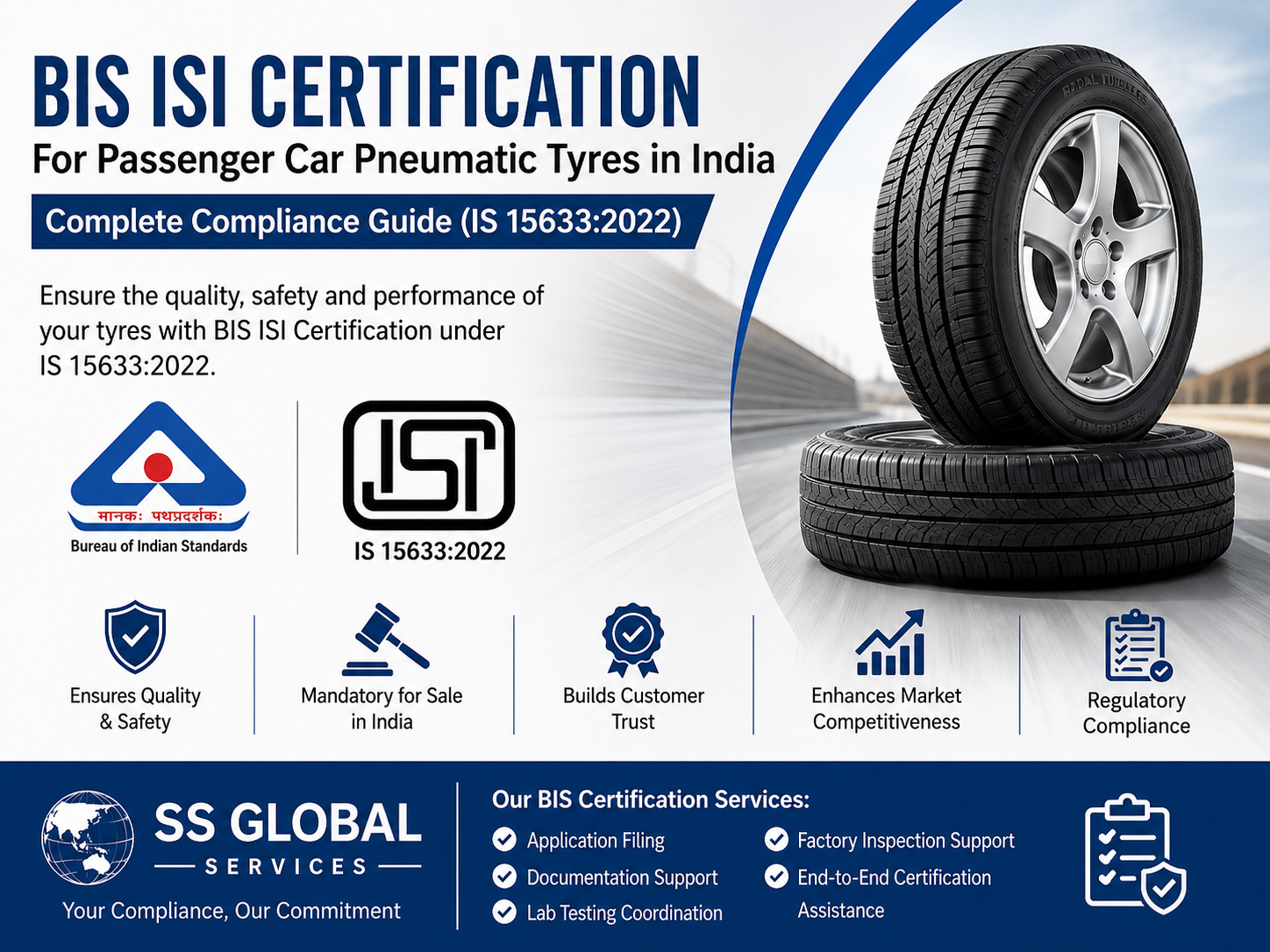
BIS ISI Certification for Passenger Car Pneumatic Tyres in India – Complete Compliance Guide (IS 15633:2022)
Passenger car tyres are one of the most important safety components of any vehicle. They play a crucial role in ensuring vehicle stability, braking performance, fuel efficiency, ride comfort, and passenger safety. To ensure that only high-quality tyres are manufactured and sold in India, the Bureau of Indian Standards (BIS) has established IS 15633:2022, the Indian Standard for passenger car pneumatic tyres.
Manufacturers and importers of passenger car tyres must obtain BIS ISI Certification before marketing applicable products in India. Compliance with this standard demonstrates that the tyres meet the required quality, safety, and performance specifications.
At SS Global Services, we provide complete consultancy services for BIS ISI Certification, helping manufacturers obtain certification smoothly through expert documentation, application support, testing coordination, and inspection assistance.
What is BIS ISI Certification?
BIS ISI Certification is a product certification scheme administered by the Bureau of Indian Standards. It verifies that a product complies with the applicable Indian Standard and meets all prescribed safety, quality, and performance requirements.
The ISI Mark is recognized throughout India as a symbol of quality and reliability. Products covered under mandatory certification cannot be legally manufactured, imported, distributed, or sold without obtaining the appropriate BIS licence.
What is IS 15633:2022?
IS 15633:2022 specifies the technical requirements for pneumatic tyres used on passenger cars. The standard covers both radial and bias-ply tyres and establishes detailed requirements for design, dimensions, performance, durability, safety, marking, and quality control.
The standard ensures that passenger car tyres provide consistent performance under various operating conditions while maintaining high standards of safety and durability.
Products Covered Under IS 15633:2022
The standard generally covers:
-
Passenger car radial tyres
-
Passenger car bias (cross-ply) tyres
-
Tubeless passenger car tyres
-
Tube-type passenger car tyres
-
New pneumatic tyres intended for passenger vehicles
Manufacturers should verify the applicability of the standard based on their specific product category.
Why is BIS ISI Certification Mandatory?
BIS certification has become an essential regulatory requirement for many automotive products to ensure public safety and product reliability.
Obtaining BIS ISI Certification helps:
-
Ensure compliance with Indian regulations
-
Improve product quality and consistency
-
Enhance road safety
-
Increase customer confidence
-
Strengthen brand reputation
-
Prevent the sale of substandard products
-
Facilitate smooth market access across India
Manufacturers who fail to obtain mandatory certification may face restrictions on manufacturing, importing, or selling their products.
Major Testing Requirements Under IS 15633:2022
Passenger car tyres undergo several performance and safety tests before certification.
1. Dimensional Verification
The tyre's dimensions, including section width and overall diameter, are verified according to the prescribed specifications.
2. Load Performance Test
The tyre is tested to ensure it can safely withstand its specified load capacity during operation.
3. Speed Performance Test
This test verifies the tyre's ability to perform safely at its designated speed rating.
4. Endurance Test
The tyre is subjected to prolonged operating conditions to evaluate its durability and long-term performance.
5. Strength Test
The tyre's structural strength and resistance to external forces are assessed.
6. Bead Unseating Test
Tubeless tyres are tested to ensure that the bead remains securely seated under operating conditions.
7. Marking Verification
The tyre markings are checked to ensure they include all mandatory information required under the applicable standard.
Documents Required for BIS Certification
Manufacturers are generally required to submit:
-
Company registration documents
-
Factory licence
-
Manufacturing process flow chart
-
Product specifications
-
Quality Control Plan
-
List of manufacturing machinery
-
Details of testing equipment
-
Calibration certificates
-
Raw material information
-
Technical drawings
-
Authorized signatory documents
-
Test reports, where applicable
Accurate documentation plays a vital role in the successful processing of the application.
BIS ISI Certification Process
The certification process generally includes the following steps:
Step 1: Product Assessment
Determine whether the product falls under the scope of IS 15633:2022.
Step 2: Documentation Preparation
Compile all technical and quality-related documents required for submission.
Step 3: Application Submission
Submit the BIS application along with the required documents.
Step 4: Product Testing
Samples are tested at a BIS-recognized laboratory to verify compliance with the applicable standard.
Step 5: Factory Inspection
BIS officials inspect the manufacturing facility, production process, quality management system, and testing infrastructure.
Step 6: Grant of BIS Licence
After successful evaluation of the product, documents, testing, and factory inspection, BIS grants the licence to use the ISI Mark.
Common Challenges During Certification
Manufacturers often encounter challenges such as:
-
Incomplete documentation
-
Incorrect application details
-
Delays in laboratory testing
-
Non-compliant testing equipment
-
Calibration issues
-
Factory inspection observations
-
Quality management deficiencies
Professional consultancy can help overcome these challenges efficiently.
Why Choose SS Global Services?
SS Global Services offers comprehensive BIS certification consultancy for manufacturers across various industries.
Our services include:
-
Product applicability assessment
-
Complete documentation support
-
BIS application filing
-
Technical documentation preparation
-
Quality Control Plan preparation
-
Scheme of Inspection and Testing (SIT)
-
Factory audit preparation
-
Coordination with BIS-recognized laboratories
-
Inspection support
-
End-to-end certification assistance until licence approval
Our experienced professionals ensure that your certification process is completed accurately, efficiently, and with minimum delays.
Benefits of BIS ISI Certification
Obtaining BIS ISI Certification provides numerous business advantages, including:
-
Legal authorization to sell products in India
-
Improved product credibility
-
Enhanced customer trust
-
Better quality assurance
-
Stronger market competitiveness
-
Compliance with government regulations
-
Increased business opportunities
Who Should Apply?
BIS ISI Certification is recommended for:
-
Passenger car tyre manufacturers
-
Foreign manufacturers exporting tyres to India
-
Importers
-
Original Equipment Manufacturers (OEMs)
-
Private label brands
-
Automotive component suppliers
Conclusion
BIS ISI Certification under IS 15633:2022 is an essential requirement for manufacturers and suppliers of passenger car pneumatic tyres in India. Compliance with this standard ensures that tyres meet stringent safety, quality, and performance requirements while enabling legal access to the Indian market.
Whether you are an Indian manufacturer or an overseas exporter, obtaining BIS certification is a valuable investment in product quality, customer confidence, and regulatory compliance.
SS Global Services provides complete end-to-end assistance for BIS ISI Certification, including documentation, application filing, laboratory coordination, factory inspection support, and post-certification guidance. Our team is committed to helping your business achieve certification efficiently and successfully.