BIS ISI Certification for PVC Insulated Copper and Aluminium Cables (IS 694:2010)
Electrical cables are the backbone of every residential, commercial, and industrial electrical installation. The quality of these cables directly impacts electrical safety, energy efficiency, and the overall reliability of power distribution systems. To ensure consistent quality and safety, the Bureau of Indian Standards (BIS) has established IS 694:2010, which specifies the requirements for PVC insulated copper and aluminium cables used for working voltages up to and including 1100 volts.
Manufacturers producing these cables for the Indian market are required to obtain BIS ISI Certification before selling products covered under the applicable Quality Control Orders (QCOs).
At SS Global Services, we provide end-to-end consultancy for BIS ISI Certification, assisting manufacturers with documentation, application filing, product testing, factory inspection, and licence approval.
What is BIS ISI Certification?
BIS ISI Certification is a product certification scheme administered by the Bureau of Indian Standards (BIS). It certifies that a product complies with the relevant Indian Standard and meets the prescribed quality, safety, and performance requirements.
The ISI Mark is a symbol of trust and quality, assuring customers that the product has been manufactured under a controlled quality management system and complies with applicable Indian regulations.
What is IS 694:2010?
IS 694:2010 specifies the requirements for PVC insulated single-core, twin-core, three-core, and multicore copper and aluminium cables used in electrical wiring for domestic, commercial, and industrial installations.
The standard covers various technical requirements, including:
-
Conductor specifications
-
PVC insulation requirements
-
Voltage rating
-
Electrical performance
-
Mechanical properties
-
Thermal performance
-
Safety requirements
-
Product marking
-
Packaging
-
Quality control procedures
Compliance with IS 694:2010 ensures that electrical cables provide reliable performance while minimizing the risk of electrical failures and fire hazards.
Applications of PVC Insulated Copper and Aluminium Cables
These cables are widely used in:
-
Residential buildings
-
Commercial complexes
-
Office buildings
-
Industrial plants
-
Educational institutions
-
Hospitals
-
Hotels
-
Shopping malls
-
Warehouses
-
Infrastructure projects
-
Electrical distribution systems
-
Internal wiring installations
Their extensive use makes quality assurance essential for public safety.
Why is BIS ISI Certification Important?
BIS Certification ensures that electrical cables consistently meet prescribed quality and safety standards before reaching the market.
Major benefits include:
-
Compliance with Indian regulations
-
Improved electrical safety
-
Consistent product quality
-
Enhanced customer confidence
-
Reduced risk of electrical failures
-
Better market acceptance
-
Increased brand credibility
-
Eligibility for government and institutional procurement
Certified products demonstrate a manufacturer's commitment to delivering safe and reliable electrical solutions.
Quality Requirements Under IS 694:2010
The standard specifies detailed requirements relating to:
-
Conductor material quality
-
Conductor resistance
-
PVC insulation quality
-
Insulation thickness
-
Sheath properties (where applicable)
-
Mechanical strength
-
Electrical insulation resistance
-
Heat resistance
-
Flexibility
-
Product identification
-
Marking and packaging
Manufacturers must maintain robust quality control systems to ensure ongoing compliance.
Testing Requirements for PVC Insulated Cables
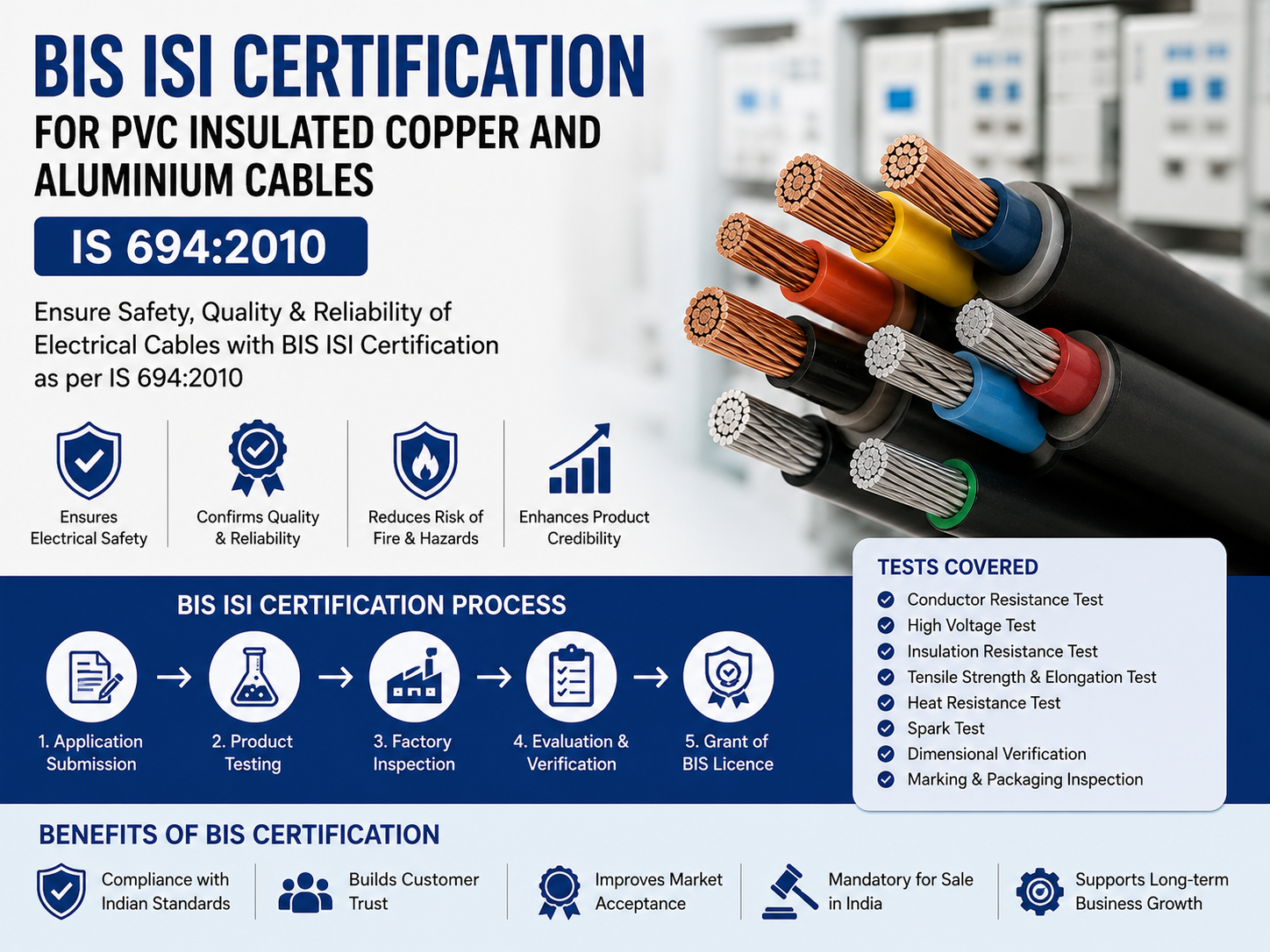
Before obtaining BIS ISI Certification, the cables undergo comprehensive laboratory testing.
1. Conductor Resistance Test
Measures the electrical resistance of the conductor to verify compliance with specified limits.
2. High Voltage Test
Checks the cable's ability to withstand the specified voltage without insulation failure.
3. Insulation Resistance Test
Evaluates the insulation's electrical resistance to ensure safety and reliability.
4. Tensile Strength and Elongation Test
Assesses the mechanical strength and flexibility of the insulation material.
5. Heat Resistance Test
Verifies the insulation's ability to withstand elevated temperatures without deterioration.
6. Spark Test
Detects insulation defects or pinholes that may affect electrical performance.
7. Dimensional Verification
Checks conductor diameter, insulation thickness, and overall cable dimensions.
8. Marking and Packaging Inspection
Ensures compliance with BIS marking and packaging requirements.
These tests help ensure that the cables are safe, durable, and suitable for long-term use.
Documents Required for BIS Certification
Manufacturers generally need:
-
Company registration documents
-
Factory licence
-
Manufacturing process flow chart
-
Product specifications
-
Quality Control Plan
-
Manufacturing machinery details
-
Testing equipment list
-
Calibration certificates
-
Raw material specifications
-
Laboratory details
-
Technical documentation
-
Quality management records
-
Authorized signatory documents
-
Previous test reports, where applicable
Complete documentation helps streamline the certification process.
BIS ISI Certification Process
The certification process generally includes the following steps:
Step 1: Product Assessment
Confirm that the product falls under IS 694:2010.
Step 2: Documentation Preparation
Prepare all technical documents and quality records required by BIS.
Step 3: Application Submission
Submit the BIS application along with supporting documentation.
Step 4: Product Testing
Product samples are tested in a BIS-recognized laboratory.
Step 5: Factory Inspection
BIS officials inspect the manufacturing facility, testing laboratory, production process, and quality management system.
Step 6: Grant of BIS Licence
After successful evaluation of documentation, testing results, and inspection findings, BIS grants the licence authorizing the use of the ISI Mark.
Common Challenges During Certification
Manufacturers often face challenges such as:
-
Incomplete documentation
-
Delays in product testing
-
Calibration issues
-
Laboratory non-compliance
-
Factory inspection observations
-
Application errors
-
Quality control deficiencies
Professional consultancy significantly reduces these challenges and helps speed up certification.
Why Choose SS Global Services?
SS Global Services provides complete BIS certification consultancy services for manufacturers across India.
Our services include:
-
Product applicability assessment
-
BIS documentation preparation
-
Application filing and coordination
-
Quality Control Plan preparation
-
Scheme of Inspection and Testing (SIT)
-
Technical documentation support
-
Laboratory testing coordination
-
Factory inspection preparation
-
Compliance consulting
-
End-to-end BIS certification support
Our experienced consultants ensure that manufacturers achieve certification efficiently while maintaining full compliance with BIS requirements.
Benefits of BIS ISI Certification
Obtaining BIS Certification offers numerous advantages:
-
Legal authorization to market products in India
-
Improved product quality
-
Greater customer confidence
-
Stronger brand reputation
-
Better market competitiveness
-
Regulatory compliance
-
Enhanced business opportunities
-
Increased acceptance in government and infrastructure projects
Who Should Apply?
BIS ISI Certification under IS 694:2010 is applicable to:
-
Electrical cable manufacturers
-
Copper cable manufacturers
-
Aluminium cable manufacturers
-
Wire and cable production companies
-
OEM manufacturers
-
Electrical equipment suppliers
-
Importers of applicable electrical cables
Conclusion
BIS ISI Certification under IS 694:2010 is an essential quality certification for manufacturers of PVC insulated copper and aluminium cables in India. Compliance with this standard ensures that products meet stringent safety, quality, and performance requirements while fulfilling applicable regulatory obligations.
Obtaining BIS certification enhances product credibility, builds customer confidence, and supports long-term business growth in the highly competitive electrical industry.
SS Global Services provides complete end-to-end consultancy for BIS ISI Certification, including documentation preparation, application filing, laboratory coordination, factory inspection support, and post-certification guidance. Our expert team is dedicated to helping manufacturers achieve certification efficiently and maintain full compliance with BIS standards.