
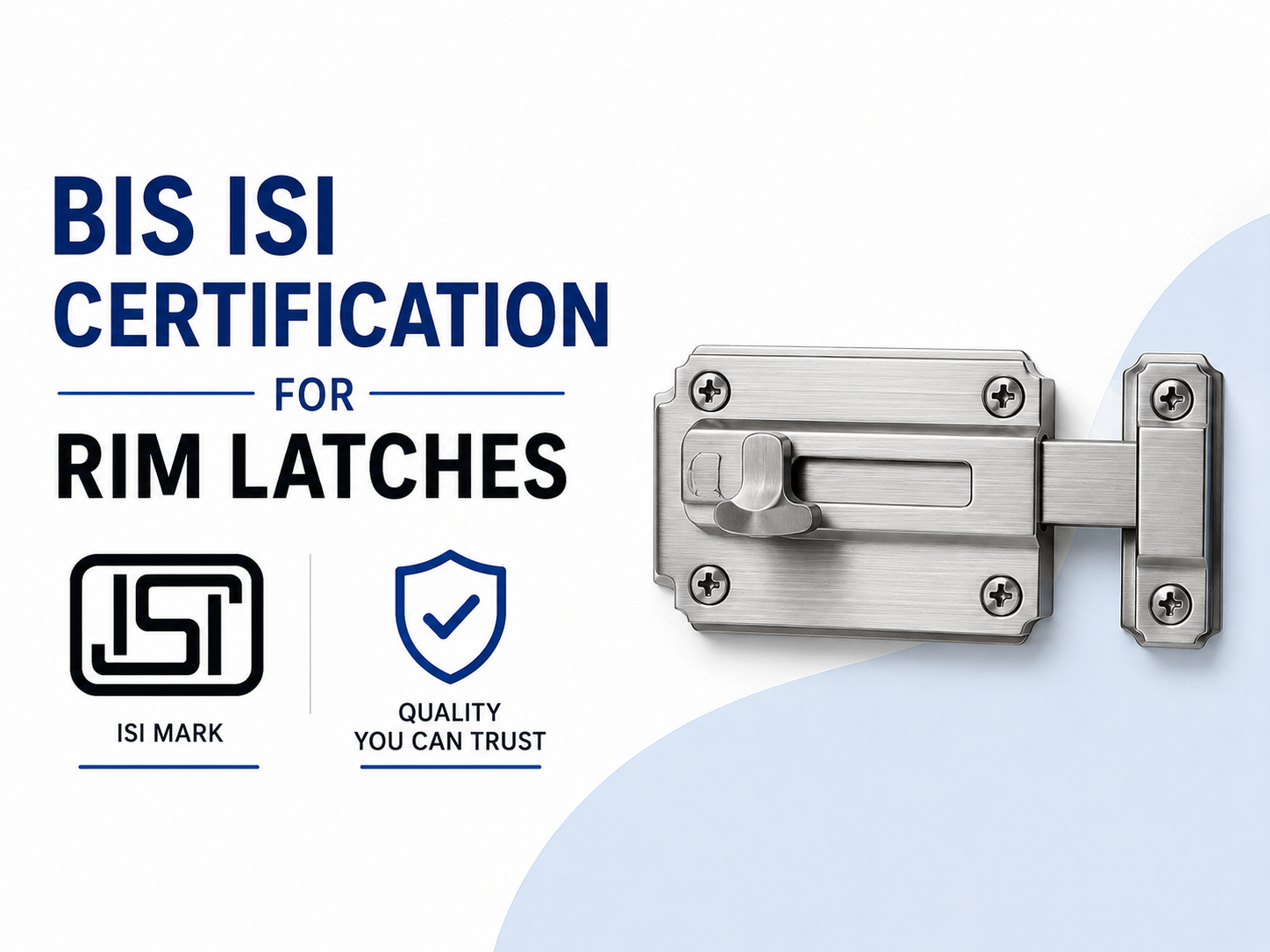
BIS ISI Certification for Rim Latches: Complete Guide for Manufacturers
Introduction
Rim latches are widely used door hardware products that provide secure and convenient locking solutions for residential, commercial, institutional, and industrial buildings. They are commonly installed on wooden and metal doors where reliable locking performance, durability, and ease of operation are essential.
To ensure the quality, safety, and performance of rim latches sold in India, the Bureau of Indian Standards (BIS) has established specific Indian Standards. Manufacturers covered under the applicable Quality Control Order (QCO) are required to obtain BIS ISI Certification before manufacturing, selling, importing, or distributing these products in the Indian market.
The ISI Mark certifies that a rim latch has been manufactured and tested in accordance with the relevant Indian Standard, providing confidence to consumers, builders, architects, and government organizations.
What is BIS ISI Certification?
BIS ISI Certification is a product certification scheme administered by the Bureau of Indian Standards (BIS). Under this scheme, manufacturers receive permission to use the ISI Mark after demonstrating that their products comply with the applicable Indian Standard through factory inspection, product testing, and quality control verification.
The ISI Mark represents:
-
Assured product quality
-
Compliance with Indian Standards
-
Reliable performance
-
Consumer safety
-
Regulatory compliance
What are Rim Latches?
A rim latch is a surface-mounted locking device fitted to the inside face of a door. Unlike mortise locks, rim latches are installed on the door surface, making them easy to install and maintain.
Rim latches are commonly used in:
-
Residential homes
-
Apartments
-
Office buildings
-
Schools and colleges
-
Hotels
-
Hospitals
-
Shops
-
Warehouses
-
Government buildings
These products are designed to provide secure door operation while maintaining durability under repeated use.
Why is BIS Certification Important?
Door hardware directly impacts the safety and security of buildings. Inferior-quality rim latches may fail prematurely, leading to security risks and increased maintenance costs.
BIS Certification ensures that rim latches:
-
Meet prescribed quality requirements
-
Provide reliable locking performance
-
Offer long service life
-
Maintain dimensional accuracy
-
Deliver consistent manufacturing quality
-
Comply with applicable Indian regulations
Benefits of BIS ISI Certification
1. Regulatory Compliance
Certification ensures compliance with applicable BIS regulations and Quality Control Orders.
2. Enhanced Product Quality
Manufacturers follow standardized production and quality control procedures.
3. Increased Customer Confidence
The ISI Mark assures buyers that the product has been independently verified.
4. Better Market Acceptance
Government departments, builders, contractors, and institutional buyers often prefer BIS-certified products.
5. Competitive Advantage
Certified products gain an edge over non-certified alternatives in the marketplace.
6. Improved Brand Reputation
BIS certification strengthens the manufacturer's credibility and demonstrates a commitment to quality.
Major Quality Requirements
To obtain BIS certification, rim latches are evaluated for compliance with the applicable Indian Standard. Typical assessments include:
-
Material quality
-
Construction and design
-
Dimensional accuracy
-
Surface finish
-
Workmanship
-
Operational performance
-
Durability
-
Strength
-
Corrosion resistance (where applicable)
-
Product marking
Testing is conducted in BIS-recognized laboratories in accordance with the relevant Indian Standard.
BIS Certification Process
Manufacturers generally follow these steps:
Step 1: Application Submission
Submit the BIS application with complete product and factory details.
Step 2: Documentation
Provide necessary documents, including:
-
Factory registration
-
GST registration
-
Manufacturing process details
-
Product specifications
-
Quality Control Plan
-
Machinery details
-
Laboratory equipment list
-
Authorized signatory documents
Step 3: Factory Inspection
BIS officials inspect the manufacturing facility to verify production capability and quality control arrangements.
Step 4: Product Testing
Product samples are tested at BIS-recognized laboratories to verify compliance with the applicable Indian Standard.
Step 5: Grant of Licence
After successful inspection and testing, BIS grants the licence to use the ISI Mark.
Step 6: Surveillance
Periodic surveillance inspections and product testing ensure continued compliance.
Documents Required
Manufacturers generally require:
-
Business Registration Certificate
-
Factory Licence
-
GST Registration
-
Manufacturing Flow Chart
-
Plant Layout
-
Machinery Details
-
Testing Equipment List
-
Calibration Certificates
-
Product Drawings
-
Raw Material Details
-
Quality Manual
-
Test Reports (if available)
Who Needs BIS Certification?
BIS certification is generally applicable to:
-
Rim Latch Manufacturers
-
Door Hardware Manufacturers
-
OEM Manufacturers
-
Contract Manufacturers
-
Brand Owners
-
Importers (where applicable)
Why Choose Professional BIS Consultants?
Obtaining BIS certification involves technical documentation, laboratory testing, factory inspections, and regulatory compliance. Professional consultants can assist with:
-
Identification of the applicable Indian Standard
-
Documentation preparation
-
BIS application filing
-
Testing coordination
-
Inspection support
-
Compliance guidance
-
Faster licence approval
Their expertise helps manufacturers complete the certification process efficiently.
Conclusion
BIS ISI Certification for Rim Latches is an important quality assurance mechanism that helps manufacturers deliver reliable, safe, and durable door hardware products. The ISI Mark demonstrates compliance with Indian Standards and enhances customer confidence while improving business opportunities.
Manufacturers planning to manufacture or market rim latches in India should ensure compliance with the applicable BIS requirements and obtain the necessary certification before introducing their products to the market.
Investing in BIS certification is not only a regulatory requirement but also a strategic investment in product quality, brand reputation, and long-term business growth.
Frequently Asked Questions (FAQs)
Is BIS Certification mandatory for Rim Latches?
If rim latches are covered under the applicable Quality Control Order (QCO), manufacturers must obtain BIS certification before manufacturing, selling, importing, or distributing the product in India.
What is the ISI Mark?
The ISI Mark is the certification mark issued by the Bureau of Indian Standards, indicating that a product conforms to the relevant Indian Standard.
How long does BIS Certification take?
The certification timeline depends on documentation, product testing, factory inspection, and BIS processing.
Can foreign manufacturers obtain BIS Certification?
Yes. Foreign manufacturers exporting rim latches to India can apply under the appropriate BIS certification scheme, subject to compliance with BIS requirements.
What are the advantages of BIS Certification?
BIS Certification improves product quality, ensures legal compliance, enhances customer trust, strengthens brand value, and provides better access to government and institutional procurement opportunities.
SEO Keywords
-
BIS ISI Certification for Rim Latches
-
BIS Certification for Rim Latches
-
ISI Mark for Rim Latches
-
BIS Certification for Door Hardware
-
BIS Certification for Door Fittings
-
Rim Latch ISI Certification
-
Bureau of Indian Standards
-
Door Hardware Certification
-
BIS Consultant for Door Fittings
-
ISI Mark Certification India