
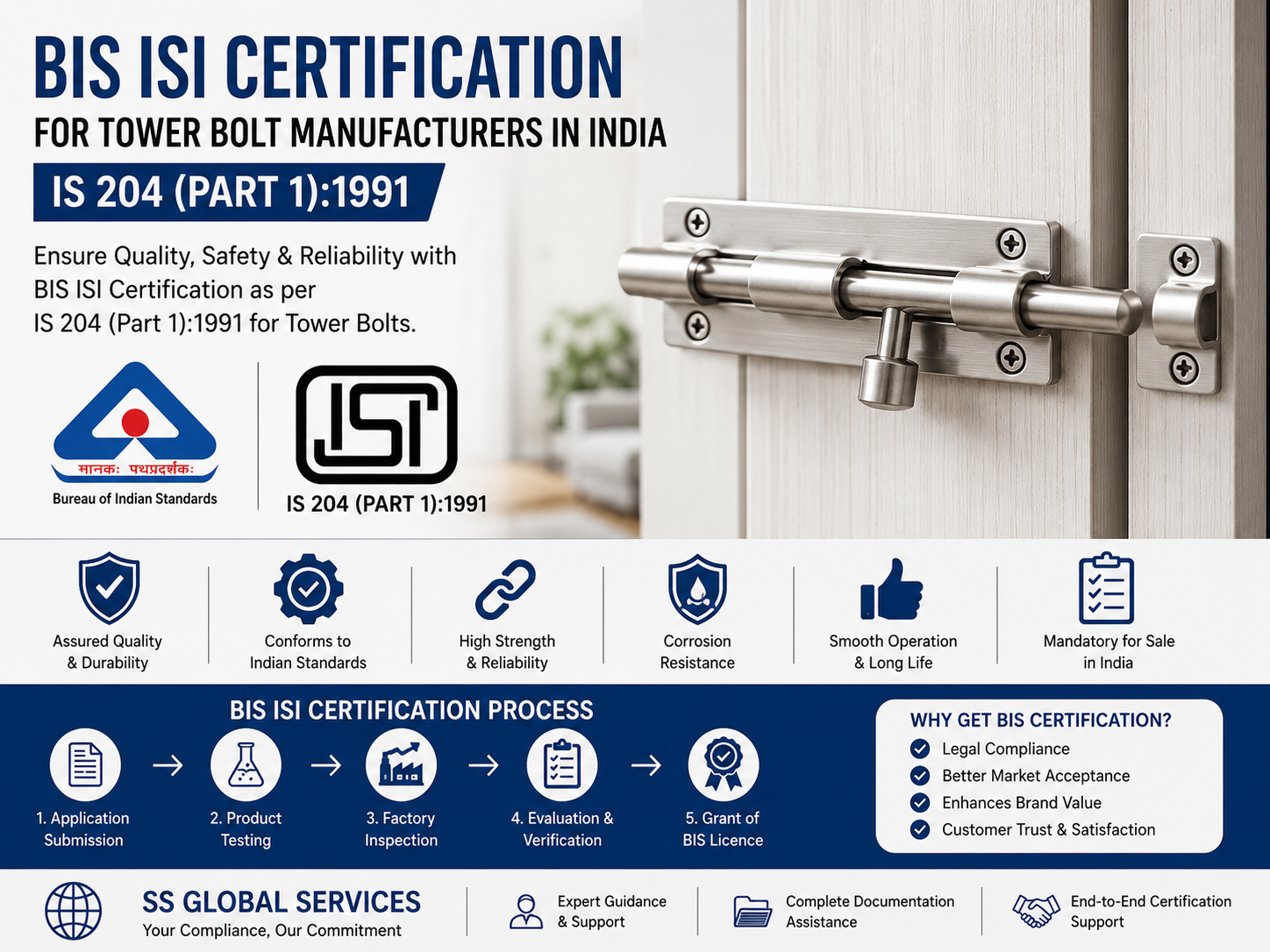
BIS ISI Certification for Tower Bolt Manufacturers in India (IS 204 Part 1:1991)
Tower bolts are essential hardware fittings used in residential, commercial, and industrial buildings to secure doors, windows, cabinets, and gates. Since these products play a vital role in ensuring safety, durability, and reliable operation, maintaining consistent quality standards is crucial.
To ensure uniform quality and performance, the Bureau of Indian Standards (BIS) has established IS 204 (Part 1):1991, which specifies the requirements for tower bolts. Manufacturers producing tower bolts covered under the applicable regulations must obtain BIS ISI Certification before marketing their products in India.
At SS Global Services, we provide complete consultancy services for BIS ISI Certification, helping manufacturers achieve compliance through documentation support, application filing, product testing, factory inspection, and licence approval.
What is BIS ISI Certification?
BIS ISI Certification is a product certification scheme administered by the Bureau of Indian Standards (BIS). It certifies that a product conforms to the relevant Indian Standard and satisfies the prescribed quality, safety, and performance requirements.
The ISI Mark is a trusted symbol of product quality and assures customers that the product has been manufactured under a controlled quality management system while meeting all applicable Indian standards.
What is IS 204 (Part 1):1991?
IS 204 (Part 1):1991 is the Indian Standard that specifies the requirements for Tower Bolts, including their materials, dimensions, workmanship, finish, performance, testing methods, packaging, and marking.
The standard helps ensure that tower bolts provide reliable locking performance, corrosion resistance, smooth operation, and long service life across different applications.
Applications of Tower Bolts
Tower bolts are commonly used in:
-
Residential doors
-
Commercial buildings
-
Office partitions
-
Industrial facilities
-
Wooden doors
-
Metal doors
-
Windows
-
Cabinets
-
Gates
-
Institutional buildings
-
Hotels and hospitals
Their widespread use makes product quality essential for both security and durability.
Why is BIS ISI Certification Important?
BIS Certification ensures that tower bolts are manufactured according to established quality standards and perform reliably during their service life.
Key benefits include:
-
Compliance with Indian regulations
-
Consistent product quality
-
Improved customer confidence
-
Enhanced product reliability
-
Better market acceptance
-
Stronger brand reputation
-
Eligibility for institutional and government procurement
-
Competitive advantage in the hardware industry
Certification demonstrates a manufacturer's commitment to delivering high-quality products.
Quality Requirements Under IS 204 (Part 1):1991
The standard specifies requirements relating to:
-
Materials used in manufacturing
-
Dimensions and tolerances
-
Mechanical strength
-
Surface finish
-
Corrosion resistance
-
Workmanship
-
Product construction
-
Sampling procedures
-
Testing methods
-
Product marking
-
Packaging requirements
Manufacturers must maintain effective quality control systems to ensure consistent compliance.
Testing Requirements for Tower Bolts
Before obtaining BIS ISI Certification, tower bolts undergo various quality and performance tests.
1. Dimensional Inspection
Checks that all dimensions conform to the prescribed tolerances.
2. Material Verification
Confirms that the specified raw materials are used in manufacturing.
3. Surface Finish Examination
Evaluates the quality of polishing, coating, plating, or finishing.
4. Mechanical Strength Test
Assesses the strength and durability of the tower bolt under normal operating conditions.
5. Corrosion Resistance Test
Verifies resistance to rust and corrosion, particularly for plated or coated products.
6. Workmanship Inspection
Ensures the product is free from defects such as burrs, cracks, sharp edges, or manufacturing imperfections.
7. Marking and Packaging Verification
Checks compliance with BIS marking and packaging requirements.
These tests help ensure reliable product performance and long service life.
Documents Required for BIS Certification
Manufacturers generally need to submit:
-
Company registration certificate
-
Factory licence
-
Manufacturing process flow chart
-
Product specifications
-
Quality Control Plan
-
Manufacturing machinery details
-
Testing equipment list
-
Calibration certificates
-
Raw material specifications
-
Technical drawings
-
Quality management records
-
Authorized signatory documents
-
Previous test reports, where applicable
Complete and accurate documentation helps facilitate faster approval.
BIS ISI Certification Process
The certification process generally includes:
Step 1: Product Assessment
Verify whether the product falls under IS 204 (Part 1):1991.
Step 2: Documentation Preparation
Prepare all technical documents and quality records required by BIS.
Step 3: Application Submission
Submit the BIS application along with the required documentation.
Step 4: Product Testing
Samples are tested in a BIS-recognized laboratory to verify compliance with the applicable standard.
Step 5: Factory Inspection
BIS officials inspect the manufacturing facility, production process, quality management system, and testing capabilities.
Step 6: Grant of BIS Licence
After successful verification of documents, testing results, and factory inspection, BIS grants the licence authorizing the use of the ISI Mark.
Common Challenges During Certification
Manufacturers often experience challenges such as:
-
Incomplete documentation
-
Product testing delays
-
Calibration deficiencies
-
Quality control gaps
-
Factory inspection observations
-
Incorrect application details
-
Non-compliance with standard requirements
Professional consultancy helps reduce delays and improves the efficiency of the certification process.
Why Choose SS Global Services?
SS Global Services provides end-to-end BIS certification consultancy for manufacturers across India.
Our services include:
-
Product applicability assessment
-
BIS documentation preparation
-
Application filing and coordination
-
Quality Control Plan preparation
-
Scheme of Inspection and Testing (SIT)
-
Technical documentation support
-
Laboratory testing coordination
-
Factory inspection preparation
-
Compliance consulting
-
Complete certification support until licence approval
Our experienced professionals help manufacturers obtain BIS certification quickly while ensuring full compliance with applicable standards.
Benefits of BIS ISI Certification
Obtaining BIS ISI Certification offers several business advantages:
-
Legal authorization to market products in India
-
Improved customer confidence
-
Stronger product credibility
-
Better quality assurance
-
Enhanced market competitiveness
-
Compliance with government regulations
-
Increased business opportunities
-
Improved brand reputation
Who Should Apply?
BIS Certification under IS 204 (Part 1):1991 is applicable to:
-
Tower bolt manufacturers
-
Architectural hardware manufacturers
-
Door hardware manufacturers
-
Building hardware suppliers
-
OEM manufacturers
-
Hardware brands
-
Importers supplying applicable products in India
Conclusion
BIS ISI Certification under IS 204 (Part 1):1991 is an important quality certification for manufacturers of tower bolts in India. Compliance with this standard ensures that products meet established requirements for quality, durability, workmanship, and performance while satisfying applicable regulatory obligations.
Obtaining BIS certification strengthens customer confidence, improves product credibility, and supports long-term business growth.
SS Global Services offers complete end-to-end consultancy for BIS ISI Certification, including documentation preparation, application filing, laboratory coordination, factory inspection support, and post-certification guidance. Our experienced team is committed to helping manufacturers achieve certification efficiently and maintain full compliance with BIS requirements.